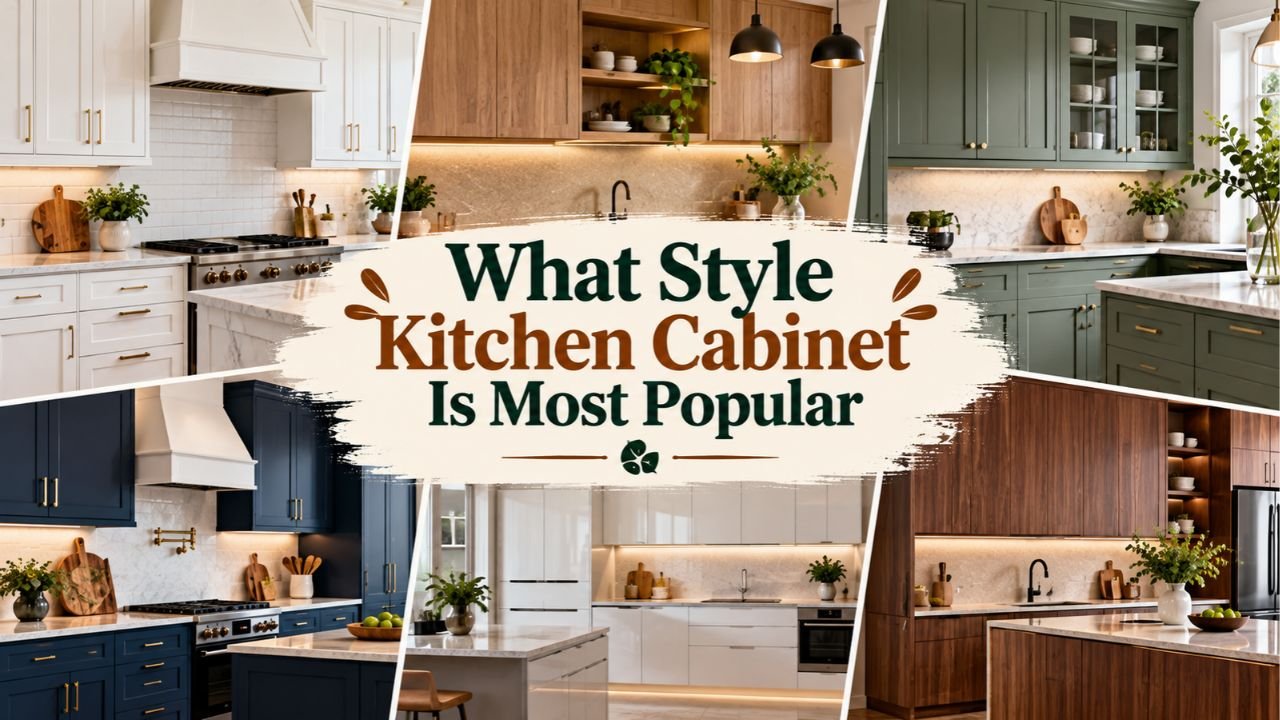
What Style Kitchen Cabinet Is Most Popular? Top Choices
Shaker-style kitchen cabinets are the most popular cabinet door design among U.S. homeowners renovating their kitchens. Their recessed center panel, simple square frame, and clean appearance work with traditional, transitional, and modern interiors. Flat-panel cabinets rank second in popularity, followed by raised-panel designs, while slim Shaker and natural wood finishes are attracting growing attention.
Choosing a cabinet style based only on appearance can lead to an expensive design mistake. Cabinets occupy a large portion of a kitchen’s visible space, and heavily decorated doors may clash with modern countertops, appliances, or the home’s architectural style.
Selecting a suitable design creates a more consistent appearance, simplifies future updates, and makes it easier to coordinate countertops, backsplashes, hardware, and flooring. Some cabinet styles also require less detailed cleaning than others.
According to the 2026 U.S. Houzz Kitchen Trends Study, Shaker doors accounted for 58% of new or upgraded cabinet door styles, compared with 22% for flat-panel cabinets and 12% for raised-panel designs. The study surveyed 1,780 U.S. homeowners involved in kitchen renovation projects.
For homeowners asking what style kitchen cabinet is most popular, the evidence points clearly toward Shaker. What stood out to me during the research was that traditional Shaker remains the leading installed style even as designers increasingly favor slimmer frames and flat slab doors.
Another detail matters: cabinet door style is different from overall kitchen design. Transitional kitchens currently lead among homeowners changing their kitchen’s appearance, while wood tones have moved slightly ahead of white as the leading cabinet color category.
The popularity rankings, cabinet design differences, current color preferences, maintenance requirements, and practical buying considerations below will help you choose a style that suits your kitchen rather than simply following a passing trend.
Read More: how to organize a deep kitchen pantry
What Style Kitchen Cabinet Is Most Popular in the United States?
Shaker cabinets are the most popular kitchen cabinet door style in the United States among homeowners replacing or upgrading cabinetry.
The 2026 Houzz study provides a useful comparison of the primary door designs selected during kitchen renovations.
| Rank | Cabinet Door Style | Share of New or Upgraded Cabinets |
| 1 | Shaker | 58% |
| 2 | Flat-panel or slab | 22% |
| 3 | Raised-panel | 12% |
| 4 | Glass-front | 3% |
| 5 | Louvered | 1% |
These figures describe the primary cabinet door styles selected by relevant respondents in the 2026 Houzz renovation study. They do not represent a census of every existing American kitchen.
Shaker cabinets lead by a substantial margin, appearing more than twice as frequently as flat-panel designs in the survey.
The previous Houzz study also placed Shaker first, at 61%, indicating that it has maintained a strong position across recent renovation surveys.
Flat-panel cabinets are the second-most-selected design, reflecting interest in smooth surfaces and minimalist kitchens.
Raised-panel doors remain present in traditional interiors, although their share is much smaller than that of Shaker.
Glass-front and louvered doors are less frequently chosen as the primary cabinet style. Glass-front doors are often installed selectively to display dishes or glassware rather than throughout an entire kitchen.
Why Are Shaker Kitchen Cabinets So Popular?
Shaker cabinets have remained common because their design is simple without appearing completely plain.
Their appearance also adapts to different finishes and surrounding materials.
Simple Five-Piece Door Construction
A traditional Shaker cabinet door typically has five main components: four frame pieces surrounding one flat center panel.
The vertical frame components are called stiles, while the horizontal components are called rails.
The center panel sits below the surrounding frame, creating a recessed appearance.
Unlike raised-panel cabinets, traditional Shaker doors avoid elaborate decorative edges and carved details.
This construction produces recognizable lines without introducing excessive visual complexity.
Shaker doors can be manufactured from solid wood, engineered wood, or combinations of suitable cabinet materials.
Works With Several Kitchen Design Styles
Shaker cabinets are associated with traditional craftsmanship, but their clean shape suits several modern interiors.
White Shaker doors with understated hardware can work in a transitional kitchen.
Natural oak Shaker cabinets may suit a kitchen with Scandinavian influences.
Painted sage green or navy Shaker doors can support a farmhouse-inspired design.
The door shape remains recognizable while changes in color, hardware, and surrounding finishes create a different appearance.
This flexibility explains part of the style’s widespread appeal.
Available Across Different Cabinet Budgets
Shaker cabinets are offered by many manufacturers in stock, ready-to-assemble, semi-custom, and custom collections.
That availability gives homeowners several purchasing options.
A basic painted Shaker door may be available in an affordable stock cabinet line.
A custom hardwood Shaker door with inset installation and premium finishing may cost considerably more.
The style itself does not guarantee a low price.
Material quality, construction, finishing, and installation methods influence the final cost.
Easier to Coordinate With Future Updates
Cabinet replacement is a substantial kitchen project.
Many homeowners want doors that will still look appropriate after changing countertops or cabinet hardware.
Shaker doors provide a relatively neutral foundation.
For example, warm brass pulls may create a different appearance from simple brushed-nickel knobs without requiring replacement of the entire cabinet.
A new backsplash or wall color can also change the visual character of a Shaker kitchen.
I consider this flexibility one of the strongest practical reasons to choose the design.
Key Takeaway: Shaker cabinets remain popular because their straightforward recessed-panel construction works with many kitchen designs, finishes, and budgets.
Most Popular Kitchen Cabinet Door Styles Compared
Shaker is the leading choice, but other door designs suit specific kitchen styles.
Understanding the differences prevents confusion when comparing cabinet samples.
1. Shaker Cabinets — Best All-Around Choice
<text weight=”medium”>Design:</text> Flat recessed center panel with a simple rectangular frame.
Shaker cabinets offer a balance between traditional detail and modern simplicity.
They work well in painted finishes, natural hardwood, and stained wood.
Their biggest advantage is versatility.
The primary drawback is the recessed area around the center panel, where dust and grease can collect.
Cleaning is straightforward with a soft cloth, but the corners require more attention than a completely flat door.
Best for: Transitional, farmhouse, contemporary, and traditional kitchens.
2. Flat-Panel or Slab Cabinets — Best for Modern Kitchens
<text weight=”medium”>Design:</text> One smooth, uninterrupted door face without a raised or recessed center panel.
A slab cabinet door creates a minimalist appearance.
It may be made from wood veneer, painted engineered wood, laminate, or another suitable cabinet material.
Flat-panel doors pair well with modern countertops, simple hardware, and clean architectural lines.
Their smooth surface is generally easier to wipe because it has fewer corners and decorative edges.
The main limitation is that large flat surfaces can reveal fingerprints, scratches, or finish imperfections, especially with glossy or dark finishes.
Slab doors are a strong option for homeowners seeking a modern kitchen without elaborate cabinet detailing.
Best for: Modern, contemporary, minimalist, and Scandinavian-inspired kitchens.
3. Raised-Panel Cabinets — Best for Traditional Kitchens
<text weight=”medium”>Design:</text> A center panel that rises above the surrounding recessed area, often with shaped or decorative edges.
Raised-panel cabinets create greater visual depth than Shaker or slab doors.
They are common in formal traditional kitchen designs.
Some feature simple profiles, while others include detailed molding, arched panels, or decorative woodwork.
Raised-panel doors can look attractive in spacious kitchens with classic architectural details.
Their limitations include more areas where dust and grease collect, along with a potentially heavier appearance in small or minimalist kitchens.
A raised-panel door is not automatically outdated. Its appearance depends on the profile, finish, and surrounding design.
Best for: Traditional, classic, and formal kitchens.
4. Glass-Front Cabinets — Best for Display Areas
<text weight=”medium”>Design:</text> Cabinet doors containing glass panels instead of solid opaque centers.
Glass-front cabinets are commonly used to display dishes, glassware, decorative objects, or collections.
Clear glass creates an open appearance, while textured or frosted glass provides partial concealment.
Some doors include decorative muntins that divide the glass into smaller sections.
Glass-front cabinets can prevent a long wall of solid cabinetry from looking too heavy.
They also introduce maintenance considerations.
Fingerprints, glass smudges, and visible cabinet contents require attention.
For most kitchens, I would use glass-front doors selectively rather than replacing every solid door.
Best for: Accent cabinets, display storage, and traditional or transitional kitchens.
5. Louvered and Beadboard Cabinets — Best for Decorative Character
<text weight=”medium”>Design:</text> Doors with horizontal slats or vertically grooved panels.
Louvered cabinet doors feature narrow horizontal slats.
They create a distinctive appearance associated with certain coastal, cottage, and decorative interiors.
Beadboard cabinet doors use repeating vertical grooves that provide a casual farmhouse or cottage character.
These styles are visually different, but both introduce more surface detail than Shaker or slab doors.
Grooves and slats can collect dust and cooking residue.
They may also become visually busy when installed across every cabinet in a compact kitchen.
A few decorative doors may provide enough character without overwhelming the room.
Best for: Cottage, coastal, rustic, and farmhouse-inspired kitchens.
Key Takeaway: Shaker offers the broadest design flexibility, slab doors suit modern spaces, and raised-panel cabinets fit traditional interiors. Glass-front, beadboard, and louvered designs work well as decorative accents.
Are Slim Shaker and Flat-Panel Cabinets Becoming More Popular?
Shaker remains the most frequently selected door style, but interest in other designs is growing.
Recent industry research points toward simpler profiles and natural materials.
Slim Shaker Cabinets
Slim Shaker cabinets retain the recessed center panel of traditional Shaker doors but use narrower surrounding rails and stiles.
The reduced frame width creates a lighter, more modern appearance.
Slim Shaker doors are often chosen by homeowners who like the character of Shaker cabinetry but want a cleaner visual profile.
They work well with natural wood finishes, warm whites, and understated hardware.
The exact frame dimensions vary by manufacturer.
A door advertised as slim Shaker by one company may have noticeably different proportions from another.
I recommend comparing actual samples before choosing a profile.
Flat Slab Doors
Flat-panel or slab cabinets have considerable momentum among kitchen design professionals.
The National Kitchen & Bath Association’s 2026 Kitchen Trends Report found that 69% of surveyed industry professionals identified flat, slab cabinet doors as gaining popularity.
That is a forward-looking professional assessment, not a claim that 69% of homeowners currently choose slab cabinets.
Actual homeowner selections still place Shaker first.
Slab doors appeal to homeowners who prefer fewer decorative details, smooth surfaces, and contemporary furniture-inspired cabinetry.
Natural wood veneer slab doors are also useful for creating a modern kitchen without relying entirely on painted surfaces.
Natural Wood Cabinetry
Warm wood cabinetry has gained attention alongside simpler door designs.
White oak, walnut, maple, and other wood species can create a warmer appearance than cool gray or stark white finishes.
Not every natural-wood cabinet is a slab design.
Wood Shaker doors remain popular, and raised-panel wood cabinetry is still an option for traditional interiors.
The strongest current pattern is the combination of simpler shapes with visible wood grain.
Key Takeaway: Slim Shaker and slab doors offer cleaner cabinet profiles, while natural wood finishes add warmth. Shaker remains the most selected door style despite growing professional interest in flat-panel designs.
What Is the Most Popular Overall Kitchen Design Style?
The most popular cabinet door style and the most popular overall kitchen design are not necessarily the same.
This distinction matters when interpreting renovation statistics.
Transitional Kitchens Lead Overall Design Choices
The 2026 Houzz study reports that 25% of homeowners changing their kitchen style selected transitional design.
Traditional kitchens followed at 12%, modern at 11%, and contemporary at 10%.
A transitional kitchen combines traditional and modern elements.
For example, it may include Shaker cabinets, understated hardware, a simple backsplash, and natural stone countertops.
The design avoids the highly decorative appearance of some traditional kitchens without becoming as minimal as certain contemporary interiors.
Shaker doors fit this approach naturally.
Door Style Is Different From Cabinet Construction
Shaker, slab, and raised-panel describe cabinet door appearances.
Other cabinet terms describe how the doors attach to the cabinet box.
Full-overlay cabinets have doors that cover most of the cabinet’s front frame or opening.
Partial-overlay cabinets leave more of the face frame visible.
Inset cabinets have doors that fit within the face-frame openings rather than resting over the frame.
These mounting methods can be combined with different door styles.
For example, a Shaker door may be installed with inset or overlay construction.
Similarly, framed and frameless describe cabinet-box construction, not the decorative profile of the doors.
A frameless cabinet has no separate face frame on the front of the box, while a framed cabinet does.
Do not confuse these construction terms with the popularity rankings for door designs.
Key Takeaway: Shaker is the leading cabinet door style, while transitional is the leading overall kitchen design among homeowners changing styles. Inset, overlay, framed, and frameless describe construction or installation rather than a separate decorative door profile.
Which Kitchen Cabinet Style Is Best for Different Kitchens?
Popularity is useful when narrowing choices, but the shape and character of the kitchen should influence the final decision.
Best Cabinet Style for a Small Kitchen
Shaker and flat-panel cabinets are both strong options for small kitchens.
Shaker doors add subtle depth without elaborate decoration.
Flat-panel doors create a smoother appearance that can make a compact kitchen feel visually simpler.
Light wood tones, warm white finishes, and consistent hardware can produce a cohesive look.
For a particularly narrow kitchen, I would consider a slim Shaker or flat-panel design rather than a heavily ornamented raised-panel door.
The door style will not physically enlarge the room, but less visual detail may reduce a crowded appearance.
Best Cabinet Style for a Modern Kitchen
Flat-panel cabinets are generally the strongest match for modern kitchens.
Their simple surfaces suit straight lines, integrated appliances, and minimal hardware.
Natural oak veneer, matte painted finishes, and other understated materials work well with slab doors.
Slim Shaker is another possibility for homeowners who prefer a hint of traditional framing.
The choice should coordinate with the home’s existing architecture rather than depend only on a design photograph.
Best Cabinet Style for a Traditional Kitchen
Raised-panel and classic Shaker cabinets are appropriate choices for traditional kitchens.
Raised-panel doors provide a more formal appearance.
Shaker doors create a simpler interpretation of traditional cabinetry.
Decorative molding, cabinet hardware, and wood finishes can influence the overall result.
A traditional kitchen does not require elaborate doors on every cabinet.
Combining restrained cabinet profiles with appropriate architectural trim can create a balanced appearance.
Best Cabinet Style for Farmhouse Kitchens
Traditional Shaker cabinets are a dependable choice for farmhouse-inspired interiors.
White, cream, muted green, and natural wood finishes can complement this style.
Beadboard doors may also provide decorative character, especially in selected areas.
I would avoid adding too many decorative details simultaneously.
For example, beadboard cabinets, heavily patterned tile, ornate hardware, and rustic wood textures can compete visually.
A simple Shaker door creates more freedom to use distinctive lighting, countertops, or flooring.
Best Cabinet Style for Easy Cleaning
Flat-panel cabinets generally require the least detailed cleaning because their surfaces have fewer recesses.
Shaker cabinets are also reasonably simple to maintain, though the frame corners need occasional attention.
Raised-panel, beadboard, and louvered designs have more grooves or decorative edges.
Finish quality matters alongside door shape.
A matte surface may hide some fingerprints better than a glossy one, although certain finishes can be more difficult to wipe without leaving marks.
Always follow the cabinet manufacturer’s cleaning recommendations.
Key Takeaway: Slab doors are a practical choice for modern kitchens and easy cleaning, while Shaker suits the greatest number of decorating styles. Raised-panel and decorative doors fit kitchens that favor traditional character.
What Kitchen Cabinet Colors and Finishes Are Most Popular?
Cabinet color and door design should be considered separately.
The same Shaker door can look substantially different in white paint, natural oak, or dark green.
Natural Wood Tones Have Taken the Lead
The 2026 Houzz study found that wood tones became the most popular cabinet color category among renovating homeowners.
The results were:
| Cabinet Color or Finish Appearance | Share of Renovating Homeowners |
| Wood tones | 29% |
| White | 28% |
| Off-white | 15% |
| Green | 6% |
| Gray | 5% |
Among wood tones, medium shades led at 15%, followed by light wood at 11% and dark wood at 3%.
These percentages describe color selections, not cabinet door styles.
A natural wood cabinet may use a Shaker, slab, or raised-panel door.
White and Off-White Remain Popular
White has lost its position as the single leading cabinet color category, but it remains common.
White and off-white together accounted for 43% of cabinet color choices in the Houzz study.
Creamy whites and other warm neutrals can pair with wood flooring, stone countertops, and brushed-metal hardware.
A white Shaker kitchen is still a reasonable choice for homeowners who prefer a bright, understated look.
I would avoid choosing an extremely cool white without comparing it against the actual countertop and wall colors.
Subtle undertone differences can become obvious once large cabinet surfaces are installed.
Green and Two-Tone Cabinet Designs
Green cabinets have become another option for homeowners seeking more color.
Sage, olive, and muted forest green can work with Shaker and slim Shaker doors.
Two-tone kitchens provide another way to use color without applying it to every cabinet.
For example, natural wood lower cabinets can be combined with warm white upper cabinets.
A darker island may also provide contrast with lighter perimeter cabinetry.
The safest approach is to compare full-size finish samples under the kitchen’s normal lighting.
A small color chip may appear different once applied across several large cabinet doors.
Key Takeaway: Wood tones now lead slightly ahead of white in U.S. renovation selections. Shaker and slab doors both work with natural wood, while warm whites and muted greens remain practical painted options.
Does Cabinet Style Affect Price, Durability, and Maintenance?
Cabinet style influences cost and care, but it does not determine the quality of the entire cabinet.
The construction of the box, door materials, finish, hardware, and installation also matter.
Stock vs. Semi-Custom vs. Custom Cabinets
Stock cabinets are manufactured in predetermined dimensions and finishes.
They generally offer lower initial costs and a more limited selection of modifications.
Semi-custom cabinets provide additional choices in sizes, finishes, door profiles, and storage features.
Custom cabinets are built to suit the project and can accommodate unusual dimensions or specialized details.
The 2026 Houzz study found that 46% of renovating homeowners selecting new or upgraded cabinetry chose custom cabinets, while 33% chose semi-custom options.
These figures describe the purchasing choices of surveyed renovators, not the popularity of a specific door profile.
A stock Shaker cabinet may cost much less than a custom inset Shaker cabinet.
Similarly, a premium wood-veneer slab door may cost more than a basic painted raised-panel door.
Door Style and Cleaning Requirements
A cabinet door’s shape influences where grease and dust accumulate.
Flat-panel doors have the fewest decorative areas.
Shaker doors contain recessed edges around the center panel.
Raised-panel doors may contain shaped edges and molding details.
Beadboard and louvered doors introduce narrow grooves that require more attention.
For routine cleaning, use a soft cloth and a product approved for the cabinet finish.
Avoid soaking wood cabinets or allowing cleaning liquid to collect along joints and edges.
Durability Depends on Construction and Finish
A simple-looking cabinet is not automatically more durable than an ornate one.
Door materials, finishing methods, moisture exposure, and hardware quality influence longevity.
Painted cabinet doors can show chips and scratches, while natural wood finishes may reveal dents or changes in color.
Some engineered-wood door panels provide good dimensional stability, but exposed edges and poorly sealed surfaces can be vulnerable to moisture.
Before ordering, inspect the cabinet’s door construction, hinge quality, drawer slides, finish warranty, and installation requirements.
I would prioritize a well-constructed cabinet in a simple style over an attractive door profile attached to a weak cabinet box.
Key Takeaway: Cabinet cost and durability depend on materials, manufacturing, finish, and installation. Shaker and slab styles are available across several price levels, while simpler door surfaces generally require less detailed cleaning.
How to Choose a Kitchen Cabinet Style in 6 Steps
A popularity ranking provides a useful starting point, but the final cabinet choice should fit the actual room.
Step 1: Identify the Kitchen’s Existing Character
Look at the flooring, windows, door trim, countertops, and architectural features.
A traditional home may suit Shaker or raised-panel cabinetry.
A modern home with simple interior trim may work better with slab or slim Shaker doors.
Try to create consistency with the surrounding space.
Step 2: Compare Full-Size Door Samples
Small photographs cannot accurately show a cabinet’s frame proportions, texture, or finish.
Request physical samples when possible.
Compare Shaker, slim Shaker, and slab doors side by side.
Pay attention to the depth of recessed panels and the width of rails and stiles.
A small change in frame width can alter the appearance of an entire cabinet wall.
Step 3: Check the Finish Under Actual Lighting
Natural daylight, warm bulbs, and cool lighting can change how cabinet colors appear.
Place samples near the countertop, backsplash, and flooring.
Inspect them during different parts of the day.
Look at the color from several positions in the kitchen.
Step 4: Consider Daily Cleaning
Think about how often the kitchen is used and how much grease or cooking residue reaches the cabinets.
Flat-panel doors provide fewer detailed areas to clean.
Traditional Shaker doors offer a balance between appearance and maintenance.
Highly decorative doors may require extra cleaning around their grooves.
Step 5: Compare Cabinet Construction and Pricing
Request itemized quotes for comparable cabinet sizes and construction levels.
Confirm the door material, finish, hinges, drawers, installation, and any required trim.
A cheaper cabinet package may exclude hardware or installation services included in another quote.
Do not compare door style alone when evaluating total project cost.
Step 6: Choose a Style You Will Still Enjoy
A current trend is not a guarantee that a cabinet will suit your preferences for years.
If you favor traditional interiors, there is no reason to abandon raised-panel cabinetry simply because Shaker ranks higher.
Similarly, a modern kitchen may look better with slab doors even though they are less common nationally.
My preference for someone without a strong design direction is a simple Shaker or slim Shaker door in a warm white or natural wood finish.
That combination offers flexibility without requiring an elaborate design.
Conclusion
For homeowners wondering what style kitchen cabinet is most popular, Shaker is the clear leader. The 2026 U.S. Houzz Kitchen Trends Study places Shaker at 58% of new or upgraded cabinet door selections, followed by flat-panel at 22% and raised-panel at 12%.
Shaker cabinets remain attractive because of their simple recessed-panel design and ability to coordinate with different kitchen styles. Flat-panel doors are a strong alternative for modern spaces, while raised-panel designs offer a more traditional appearance. Natural wood, warm whites, and restrained cabinet details are also common choices.
I recommend beginning with Shaker if you want a widely used, flexible cabinet style. Choose slab cabinets for a more minimal appearance or raised-panel doors for a classic interior. Compare physical samples, construction quality, and finish options before committing to a full kitchen installation.
FAQs About Popular Kitchen Cabinet Styles
Are Shaker kitchen cabinets still popular?
Yes. Shaker remains the most popular cabinet door style among U.S. homeowners renovating their kitchens.
The 2026 Houzz study found that 58% of new or upgraded cabinet door selections were Shaker.
The design has remained popular because it works with several kitchen styles and is available in many finishes and construction levels.
Slim Shaker versions also provide a newer interpretation of the traditional recessed-panel door.
Are Shaker cabinets going out of style?
Current U.S. renovation data does not indicate that Shaker cabinets have lost their leading position.
Flat-panel and slim Shaker designs are attracting interest, but classic Shaker remains the most frequently selected cabinet door style.
Its relatively simple appearance works with changing hardware, countertops, and color preferences.
No cabinet style is guaranteed to remain fashionable indefinitely. Still, Shaker offers a flexible design that is not strongly tied to one decorative trend.
Are flat-panel cabinets more modern than Shaker cabinets?
Flat-panel cabinets generally create a more modern and minimalist appearance.
Their doors have smooth surfaces without raised or recessed center panels.
Shaker cabinets include a visible frame surrounding a recessed panel, giving them additional detail.
Both styles can work in contemporary kitchens.
Flat-panel doors are usually the stronger choice for a highly minimal design, while slim Shaker doors provide a compromise between modern simplicity and traditional character.
What is the most popular kitchen cabinet color?
Wood tones were the leading cabinet color category in the 2026 U.S. Houzz Kitchen Trends Study, chosen by 29% of renovating homeowners.
White followed closely at 28%, with off-white at 15%.
Medium wood tones were the most common within the wood category.
These rankings reflect recent renovation selections rather than every existing kitchen in the country.
Which kitchen cabinet style is easiest to clean?
Flat-panel or slab cabinets are generally the easiest to wipe because their doors have smooth surfaces without recessed corners or decorative molding.
Shaker cabinets are also fairly easy to maintain, although grease and dust may collect around the center-panel edges.
Raised-panel, beadboard, and louvered doors have additional grooves or details.
The cabinet finish matters as well. Use cleaning products approved by the manufacturer to avoid damaging paint, veneer, or protective coatings.
What is the difference between Shaker and recessed-panel cabinets?
Shaker is a type of recessed-panel cabinet door.
It has a flat center panel surrounded by a simple frame with relatively straight, understated edges.
Other recessed-panel designs may include decorative molding, shaped inner edges, or more elaborate profiles.
All traditional Shaker doors belong to the broader recessed-panel category, but not every recessed-panel door follows the Shaker design.
Are inset cabinets more popular than overlay cabinets?
Inset and overlay describe how cabinet doors fit the cabinet box rather than the decorative door style.
Inset doors fit within the front opening of a face frame, often creating a furniture-like appearance.
Overlay doors cover part or most of the cabinet’s front.
The 2026 Houzz cabinet door popularity rankings do not establish a direct national comparison between inset and overlay installation methods.
Shaker and other door styles can be manufactured in either configuration.
What kitchen cabinet style is best for resale value?
Shaker cabinets are a reasonable choice for homeowners concerned about broad buyer appeal because they are common, relatively understated, and compatible with different interiors.
Flat-panel cabinets may be attractive in homes with modern architecture.
Cabinet style alone does not guarantee a higher resale price.
Buyers may also evaluate cabinet condition, storage capacity, layout, finish quality, and the kitchen’s overall appearance.
I would favor durable, well-installed cabinetry with restrained finishes over spending heavily on decorative details solely for a possible future resale benefit.





One Comment