How to Organize a Deep Kitchen Drawer: Dividers and Layout Tips
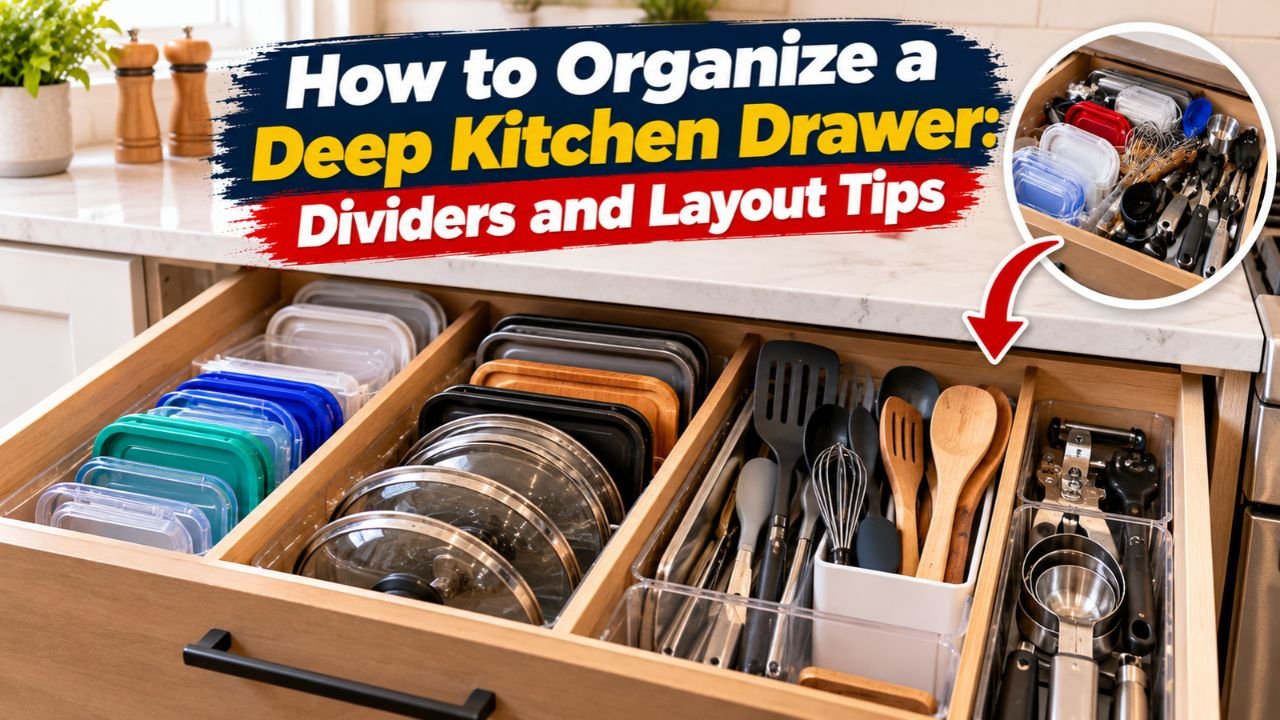
The best way to organize a deep kitchen drawer is to remove everything, group similar items, and use adjustable dividers, pegboards, or storage bins to keep each category in its own space. Store frequently used items near the front, keep heavy cookware stable, and use vertical organizers for lids, cutting boards, and baking trays.
Deep kitchen drawers provide generous storage space, but their size can also create problems. Pots slide around, plastic containers become mixed up, and small utensils disappear beneath larger items.
Unlike shallow drawers designed primarily for cutlery, deep drawers can accommodate bulky cookware, dinnerware, pantry supplies, and even small appliances. The challenge is making that storage accessible without stacking everything into one crowded space.
A useful organization system should match the drawer’s dimensions, weight capacity, and location in the kitchen. It should also remain easy to maintain during everyday cooking.
In this article, I cover how to measure and organize deep kitchen drawers, choose suitable dividers and organizers, and arrange pots, pans, lids, dishes, and food containers. I also explain budget-friendly DIY solutions, common storage mistakes, and ways to keep drawers organized long-term.
How to Organize a Deep Kitchen Drawer Step by Step
Start by emptying the drawer, measuring its usable space, and deciding which items belong together. Then create separate storage zones using organizers that fit the drawer and its contents.
This process works for deep drawers beneath countertops, kitchen islands, and lower cabinets.
Step 1: Remove Everything From the Drawer
Take every item out and place it on a nearby counter or table.
Do not begin rearranging things while the drawer is still full.
An empty drawer makes it easier to see the available space and identify items that no longer belong there.
As you remove the contents, check for:
- Duplicate kitchen utensils
- Missing food storage container lids
- Broken or damaged cookware
- Unused small appliances
- Expired pantry products
- Items belonging in another kitchen area
- Accessories that are difficult to reach or rarely used
Set aside anything you no longer need.
Avoid keeping unnecessary objects simply because the drawer has room for them.
Step 2: Clean the Drawer Thoroughly
Use a vacuum or soft brush to remove loose crumbs and dust.
Wipe the interior with a cleaner suitable for the drawer material.
Pay attention to the corners and edges where food particles can accumulate.
Allow the drawer to dry before adding a liner or placing items back inside.
If the drawer contains removable organizers, clean them separately according to their manufacturer’s instructions.
Avoid leaving moisture trapped beneath plastic mats or storage containers.
Step 3: Measure the Inside of the Drawer
Measure the usable space before purchasing organizers.
You need three dimensions:
| Measurement | What to Measure |
| Width | Inside distance between the drawer’s sidewalls |
| Depth | Inside distance from the drawer front to the back |
| Usable height | Clearance from the drawer bottom to the underside of the cabinet or drawer above |
Use the narrowest usable measurements when obstructions are present.
Check the position of drawer slides, brackets, screw heads, and other hardware.
For example, a drawer with an inside width of 26 inches may need an organizer slightly narrower than 26 inches to fit comfortably.
Also, remember that the height of the drawer front does not necessarily equal the usable height inside the cabinet.
Measure the clearance with the drawer positioned as it normally operates.
Step 4: Sort Items Into Categories
Group objects according to their purpose.
Possible categories include:
- Pots and saucepans
- Frying pans
- Pot and pan lids
- Baking trays
- Cutting boards
- Mixing bowls
- Food storage containers
- Container lids
- Cooking utensils
- Small kitchen appliances
- Dry pantry supplies
The goal is to identify items that make sense to store together.
For example, keeping saucepans and their lids in the same drawer can make meal preparation more convenient.
Avoid combining unrelated objects simply because they fit.
Step 5: Choose a Main Purpose for the Drawer
A deep drawer works best when it has a clear primary function.
For example, a drawer beside the stove may be ideal for cookware.
A drawer near the dishwasher may work better for plates and bowls.
A drawer beneath the main preparation counter may be useful for mixing bowls and food storage containers.
Choose the purpose based on where you use the contents most often.
Step 6: Divide the Available Space Into Zones
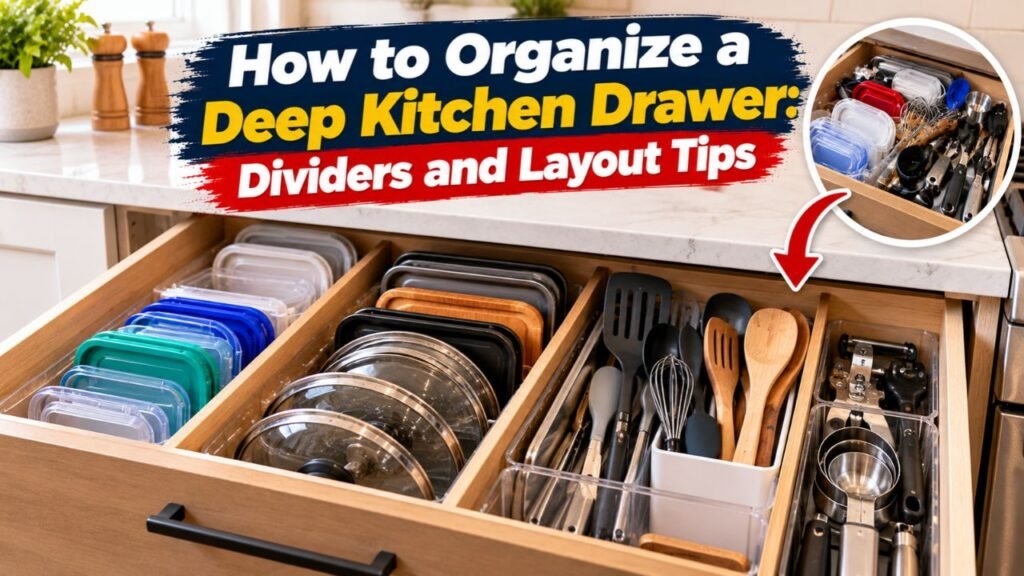
Use dividers, bins, or adjustable pegs to create separate areas.
For a large cookware drawer, the layout might include:
- Left section: Frying pans
- Center section: Saucepan and stockpot
- Right section: Pot lids
- Front section: Frequently used accessories
The exact arrangement depends on the contents and the drawer’s size.
Leave enough clearance to lift items without hitting the underside of the countertop.
Step 7: Place Frequently Used Items Within Easy Reach
Store everyday items where they can be accessed with minimal movement.
Less frequently used objects can go toward the back of a full-extension drawer.
However, if the drawer does not open completely, avoid placing important items in areas that are difficult to reach.
Position heavy or fragile objects securely so they cannot shift when the drawer is opened.
Step 8: Test the Drawer Before Finishing
Open and close the drawer several times.
Check whether anything moves, falls, catches, or makes excessive noise.
Make sure:
- Organizers remain in position.
- Tall objects clear the cabinet opening.
- Nothing blocks the drawer slides.
- Heavy items are properly supported.
- Lids and trays can be removed easily.
- The drawer closes without force.
Adjust the layout before considering the project finished.
Key Takeaway: Emptying, measuring, categorizing, and testing the drawer creates a more reliable organization system than simply adding storage bins to an already crowded space.
Best Organizers for Deep Kitchen Drawers
The most suitable organizer depends on what you want to store.
A pegboard works well for plates and cookware, while adjustable dividers are more useful for separating large objects.
1. Adjustable Drawer Dividers
Adjustable dividers create separate compartments without requiring a permanently fixed layout.
They can be useful for:
- Cooking utensils
- Food storage lids
- Baking supplies
- Dish towels
- Mixing bowls
- Small pantry containers
Choose dividers that fit the inside dimensions and remain securely positioned.
Some models use tension mechanisms, while others attach to compatible drawer systems.
For tall drawers, select dividers high enough to prevent the contents from falling across compartment boundaries.
2. Pegboard Drawer Organizers
A pegboard organizer is especially useful for large, wide drawers.
It typically consists of a base panel with movable pegs.
The pegs can be positioned around plates, bowls, pots, or other objects to reduce movement.
For example, IKEA’s cookware organization guide recommends adjustable pegboard organizers and dividers for keeping pots, pans, and lids in position.
Pegboards work particularly well when the drawer contains several objects of different sizes.
However, they must fit the drawer floor and provide appropriate support for the contents.
3. Vertical Lid Organizers
Pot and pan lids can be difficult to store in stacks.
A vertical organizer holds them upright in separate slots.
This allows you to remove one lid without lifting an entire pile.
Choose a rack with enough clearance for the lid handles.
The rack should be secured or have a stable base so it does not slide when the drawer moves.
4. Deep Storage Bins
Bins can help organize smaller items inside a large drawer.
They are particularly useful for:
- Food storage container lids
- Measuring cups
- Baking accessories
- Reusable food bags
- Small kitchen gadgets
- Packaged pantry items
Choose containers with straight sides to make efficient use of the drawer’s width.
Open-top bins are often more convenient than lidded boxes for frequently used items.
However, avoid stacking several tall bins if the upper containers become difficult to reach.
5. Non-Slip Drawer Liners
Non-slip liners reduce movement and help protect the drawer surface.
They can be useful beneath:
- Cookware
- Dish organizers
- Storage bins
- Small appliances
- Glass containers
Select a liner suitable for the drawer finish.
Some rubberized materials can interact with certain coatings, so follow the cabinet manufacturer’s recommendations.
A liner helps reduce sliding but does not replace a proper divider for heavy or unstable objects.
6. Plate and Bowl Holders
Specialized plate holders keep stacks of dishes positioned securely.
Some designs use adjustable supports, while others use removable carriers.
These organizers are useful for deep drawers near the dishwasher.
Make sure the holder accommodates the diameter and height of the dishes.
Also, verify that the drawer hardware can safely support the total weight.
7. Modular Drawer Organization Systems
Some cabinet manufacturers offer complete drawer organization systems.
For example, Blum’s ORGA-LINE system provides adjustable compartments designed to organize kitchen utensils, cookware, and other drawer contents.
Such systems are designed to fit particular drawer hardware.
They can provide a stable, coordinated arrangement, but compatibility must be checked before purchase.
A universal organizer may be more practical for a kitchen with older or unidentified drawer hardware.
Key Takeaway: Adjustable dividers are versatile, pegboards are useful for cookware and dishes, and vertical organizers work particularly well for lids and trays. Choose organizers according to the actual contents rather than appearance alone.
What Should You Store in a Deep Kitchen Drawer?
Deep kitchen drawers are best suited to items that benefit from easy access from above.
They are particularly useful for objects that are awkward to retrieve from traditional lower cabinets.
Pots and Pans
Pots and pans are among the best items to store in deep drawers.
Unlike a cabinet shelf, a full-extension drawer lets you view the contents from above.
Arrange cookware by size or frequency of use.
For example:
- Everyday frying pans near the front
- Saucepan beside frequently used cookware
- Larger stockpot toward the back
- Matching lids in an adjacent compartment
Keep large handles from catching on the sides or blocking movement.
Plates and Bowls
Deep drawers can accommodate stacks of dinner plates, cereal bowls, and serving dishes.
This arrangement can make dishes easier to reach than items stored on high shelves.
However, ceramic and stoneware dishes are heavy.
Check the drawer’s load rating before moving an entire dinnerware collection into one compartment.
Use suitable peg organizers or plate holders to prevent stacks from shifting.
Food Storage Containers
Plastic and glass food storage containers can quickly create clutter when mixed with their lids.
Deep drawers provide space for organizing them by shape and size.
Nest compatible containers when practical.
Keep lids in a separate divided section so they remain visible.
Avoid storing more containers than you regularly use.
Mixing Bowls and Colanders
Large mixing bowls and colanders are well suited to deep drawers because they are often awkward to store in shallow cabinets.
Nest bowls of compatible shapes and sizes.
Keep the most frequently used bowls accessible.
Avoid building a stack so tall that you must remove several items to reach the one at the bottom.
Small Kitchen Appliances
Certain small appliances can be stored in deep drawers when the drawer is designed for their size and weight.
Examples may include:
- Hand mixers
- Compact food processors
- Immersion blenders
- Kitchen scales
- Small electric choppers
Store electrical cords neatly.
Do not force appliances into a drawer where their controls or housings may be damaged.
Check the appliance’s storage instructions and ensure that it is cool, clean, and dry before storing.
Pantry Supplies
Deep drawers can also serve as pull-out pantry storage.
They may hold:
- Pasta packages
- Rice containers
- Flour containers
- Cereal containers
- Canned goods
- Baking supplies
Use stable containers to prevent items from tipping.
Heavy canned goods can quickly create substantial loads, so check the drawer’s rated capacity.
Key Takeaway: Deep drawers are particularly useful for cookware, dishes, food containers, and bulky kitchen equipment. Store objects according to how frequently they are used and whether the drawer can safely support them.
How to Organize Pots and Pans in a Deep Kitchen Drawer
Pots and pans often take up more space than their shape suggests.
Handles, lids, and different diameters can make ordinary stacking inefficient.
Arrange Pans by Size
Place larger pans toward the back or in a designated section.
Keep the most frequently used frying pan easy to reach.
If the drawer is wide enough, arrange cookware in separate groups rather than one large stack.
This reduces the number of objects you need to move during cooking.
Use Dividers to Separate Cookware
Adjustable dividers can create compartments for different types of pots.
For example, one section may hold frying pans while another contains saucepans.
For drawers with irregularly shaped cookware, a pegboard may provide greater flexibility.
Position the supports around the items rather than squeezing them tightly together.
Protect Nonstick Cookware
Nonstick pans can become scratched when stacked directly against other cookware.
Use compatible pan protectors or soft separators when stacking.
Avoid placing rough metal bases directly against delicate interior coatings.
Follow the cookware manufacturer’s storage and care instructions.
Keep Handles From Interfering With the Drawer
Pan handles can extend beyond the main body of the cookware.
Check that handles do not contact the sides of the cabinet or become trapped when closing.
Turning handles in a consistent direction may help.
For unusually long handles, a wider drawer or separate storage location may be necessary.
Key Takeaway: Organize cookware by size and frequency of use, use dividers to prevent movement, and protect nonstick surfaces from direct contact with harder objects.
How to Organize Pot Lids in Deep Kitchen Drawers
Pot lids are often one of the most difficult kitchen items to organize.
They vary in diameter, may have raised handles, and can slide when stacked.
Store Lids Vertically
Vertical storage makes individual lids easier to identify.
A lid rack can hold several sizes in separate slots.
Place larger lids behind smaller ones when that arrangement makes the handles easy to reach.
Avoid positioning fragile glass lids where they can fall forward.
Keep Matching Lids Near Their Pots
If space permits, store cookware and matching lids in adjacent compartments.
This reduces time spent searching for the correct lid.
For example, a saucepan may occupy one section while its lid stands upright immediately beside it.
Use Adjustable Dividers for Mixed Lid Sizes
A fixed rack may not fit every lid.
Adjustable dividers can accommodate unusual handles or larger diameters.
Measure the widest lid before purchasing a rack.
Also, check its height with the lid positioned vertically.
A lid that fits within the drawer when lying flat may be too tall when stored upright.
Avoid Overcrowding Glass Lids
Glass lids can chip or break when repeatedly knocked against hard objects.
Use stable separators.
Do not place heavy cookware on top of delicate glass lids.
Keep lids with damaged or loose handles out of ordinary storage until repaired or replaced.
Key Takeaway: Vertical lid storage reduces clutter and makes matching lids easier to retrieve. Measure both diameter and height before choosing an organizer.
How to Organize Food Storage Containers in a Deep Drawer
Food storage containers are another common source of kitchen clutter.
Their containers and lids often become separated, leaving several mismatched pieces.
Sort Containers by Shape and Size
Group similar containers together.
For example:
- Small round containers
- Medium round containers
- Square containers
- Rectangular meal-prep containers
- Large food storage boxes
Nest only containers designed to fit together safely.
Avoid forcing containers into one another because they can become difficult to separate.
Store Container Lids Separately
Use a shallow bin or vertical divider to organize lids.
Group lids by matching container type.
If you have several different brands, label the sections where useful.
Avoid storing lids in one large pile.
You should be able to identify the correct lid without emptying the drawer.
Remove Containers Without Matching Lids
Check whether each container has an appropriate lid.
Set aside damaged, warped, or incomplete items.
If the remaining container has another practical use, keep it in a suitable location.
Otherwise, remove unnecessary pieces from the kitchen storage system.
Store Everyday Containers Near the Front
Place frequently used lunch containers and meal-prep boxes near the front.
Larger seasonal storage containers can go toward the back.
This makes the drawer easier to use during everyday meal preparation.
Key Takeaway: Sort containers by shape, nest compatible sizes, and keep matching lids in clearly divided sections. Removing unmatched pieces makes the system easier to maintain.
How to Organize a Deep Drawer for Plates and Bowls
Wide, deep drawers can provide convenient storage for everyday dinnerware.
However, dishes require more attention to stability and weight than lightweight plastic containers.
Use Pegboards to Secure Plates
Adjustable peg organizers can hold stacks of dishes in designated positions.
This reduces shifting when the drawer is opened or closed.
Keep enough space around the stacks to lift dishes without hitting nearby objects.
Stack Similar Dishes Together
Group dinner plates, salad plates, and bowls separately.
Avoid mixing several sizes in one unstable pile.
Shorter, more stable stacks are often easier to use than tall ones.
If the drawer has sufficient width, create several separate stacks instead of one large stack.
Place Heavy Dishes in Lower Drawers
Heavy dinnerware is generally easier to handle when stored at a comfortable lifting height.
However, a lower location does not guarantee that the drawer can carry unlimited weight.
Check the manufacturer’s load rating.
For example, a set of stoneware dinner plates can place considerable weight on the drawer slides when combined with bowls and serving dishes.
Distribute the load across the drawer rather than concentrating everything in one small area.
Check for Clearance Above the Dishes
Before finishing, close the drawer slowly.
Make sure the tallest stack clears the cabinet structure.
Do not force the drawer shut if the contents catch.
A plate holder may increase the overall height of the stored dishes, so measure the combined height before purchasing.
Key Takeaway: Plate organizers and pegboards help keep dinnerware stable. Check the drawer’s weight rating and overhead clearance before storing heavy stacks of dishes.
How to Organize Deep Kitchen Drawers by Location
The location of a drawer often determines its most useful purpose.
A storage system should support the way the kitchen is used.
Deep Drawers Near the Stove
Drawers beside the cooking area work well for:
- Pots and pans
- Saucepan lids
- Cooking utensils
- Oven-safe accessories
- Frequently used cookware
Keeping cookware near the stove reduces unnecessary movement during meal preparation.
However, do not store heat-sensitive products in drawers exposed to unusual appliance heat.
Also, confirm whether a drawer beneath an oven is an ordinary storage drawer, warming drawer, or broiler compartment before using it for kitchen storage.
Deep Drawers Near the Dishwasher
A drawer near the dishwasher can be convenient for:
- Dinner plates
- Bowls
- Serving dishes
- Everyday food containers
This arrangement can make unloading easier.
Place frequently used dishes where they can be retrieved without excessive bending or lifting.
Deep Drawers Under the Prep Counter
Drawers near the main food preparation area may be useful for:
- Mixing bowls
- Measuring tools
- Colanders
- Cutting boards
- Food storage containers
- Small preparation appliances
Keep similar items together.
A divided drawer with a few well-defined categories is generally easier to manage than one containing every kitchen gadget.
Deep Drawers in a Kitchen Island
Kitchen islands often provide wide drawers with convenient access from the main working area.
Depending on the island’s purpose, they may hold cookware, baking supplies, serving dishes, or food storage containers.
If the island includes seating, make sure open drawers do not obstruct normal movement around the kitchen.
Key Takeaway: Organize drawers according to the nearest kitchen task. Cookware belongs near cooking, dinnerware near unloading, and preparation tools near the main workspace whenever the layout allows.
DIY Deep Kitchen Drawer Organizers on a Budget
You do not need a complete custom cabinet system to organize a deep drawer effectively.
Several inexpensive solutions can create useful compartments.
Use Adjustable Tension Dividers
Tension dividers are simple to install and can be repositioned when storage needs change.
They work well for separating large objects without permanently modifying the drawer.
Make sure the divider’s height and tension are appropriate for the drawer.
Avoid overtightening mechanisms that could damage the sidewalls.
Make Wooden Drawer Dividers
A simple wooden divider system can be built using thin, smooth boards.
Measure the drawer carefully.
Cut the pieces to fit the desired layout.
Sand the edges so they will not scratch cookware or hands.
Use an appropriate removable or securely fitted design.
Avoid driving screws into drawer sides without checking for hidden hardware or manufacturer restrictions.
Use Existing Storage Bins
Small plastic bins and washable containers can organize utensils, lids, and pantry supplies.
Choose bins that fit closely together without wedging against the drawer walls.
Add a suitable non-slip mat underneath if necessary.
Avoid using weak cardboard containers for areas exposed to moisture or heavy cookware.
Use a Non-Slip Liner Without Additional Dividers
Sometimes a simple liner is enough.
A drawer containing only two or three large pots may not need several bins.
A non-slip mat can reduce movement and protect the surface.
For heavy or unstable objects, combine the liner with appropriate supports.
Repurpose Suitable Kitchen Containers
Clean, sturdy containers can be reused for organizing small accessories.
For example, a shallow tray may hold measuring spoons or reusable bag clips.
Make sure reused containers are dry, stable, and easy to clean.
Avoid materials with sharp edges or unknown chemical residues.
Key Takeaway: Adjustable dividers, simple wooden compartments, reusable bins, and non-slip liners can organize a deep drawer without expensive custom accessories.
How to Keep Items From Sliding in Deep Kitchen Drawers
Items that shift during opening and closing can create noise, damage cookware, and make organization difficult.
The problem is particularly noticeable in wide drawers containing heavy objects.
Use Non-Slip Drawer Mats
A non-slip liner can reduce movement between the drawer bottom and stored items.
Choose a material suitable for the interior finish.
Keep the mat clean and dry.
If it curls or shifts, trim it to fit or replace it with a more suitable product.
Add Adjustable Pegs or Dividers
Pegboards and dividers create physical boundaries around stored items.
This is generally more effective than relying entirely on friction for plates, pots, and other heavy objects.
Adjust the compartments so objects remain secure without being tightly wedged together.
Avoid Overloading the Drawer
Overloading can cause excessive wear, poor movement, or hardware failure.
Heavy cookware and dishes add considerable weight.
Check the drawer slide or cabinet manufacturer’s rated load capacity.
A drawer that opens smoothly while empty may struggle when overloaded.
Distribute Weight Evenly
Avoid placing every heavy object in one corner.
Spread the load across the usable drawer area where practical.
Keep the center of gravity reasonably low.
Do not stack unstable heavy objects where they could fall when the drawer is opened.
Check Drawer Slide Alignment
If objects slide consistently toward one side, inspect whether the drawer is level and operating correctly.
Damaged or misaligned slides may affect drawer movement.
Do not force an overloaded drawer or continue using hardware that appears loose or damaged.
Key Takeaway: Non-slip mats reduce minor movement, while dividers and pegs provide better control for heavy items. Proper load distribution and functioning drawer slides are equally important.
Common Deep Kitchen Drawer Organization Mistakes
Deep drawers provide generous storage, but using every available inch can make them less practical.
Several mistakes are easy to avoid.
Filling the Drawer With Too Many Items
Overcrowding makes it difficult to retrieve cookware and may exceed the drawer’s load rating.
Remove duplicates and rarely used objects before installing organizers.
Leave enough room to lift items comfortably.
Buying Organizers Before Measuring
A divider may fit the drawer’s width but be too tall for the cabinet opening.
A bin may also interfere with hardware or prevent the drawer from closing.
Always measure usable width, depth, and height first.
Stacking Everything Horizontally
Large stacks can hide items and make them difficult to retrieve.
Use vertical storage for suitable lids, trays, and cutting boards.
However, confirm that vertical objects clear the cabinet opening.
Ignoring Weight Capacity
Heavy dishes, cast iron cookware, and canned goods can overload drawer slides.
Do not assume that a deep drawer is designed to carry unlimited weight.
Follow the cabinet hardware manufacturer’s load specifications.
Storing Sharp Knives Loose
Loose kitchen knives can create a cutting hazard when reaching into the drawer.
Use a suitable knife tray, protective sheath, or dedicated knife organizer.
Keep exposed blades secured.
If children can access the drawer, consider appropriate child-resistant safety measures.
Using Too Many Small Containers
A large number of small bins can waste space and make bulky cookware difficult to store.
Choose organizers based on the number and size of your belongings.
For pots and pans, larger adjustable sections may be more useful than several individual bins.
Forgetting About Cleaning
Food crumbs, spills, and dust can collect under organizers.
Choose removable products when possible.
Avoid permanently attaching storage accessories that make routine cleaning difficult.
Creating a Layout That Is Too Complicated
A highly detailed storage system may look attractive initially but become difficult to maintain.
Make sure each category has an obvious location.
A practical system should be easy to use even during busy cooking.
Key Takeaway: The most common mistakes are overcrowding, incorrect measurements, unstable stacks, and ignoring drawer weight limits. Simple, accessible compartments usually work best.
How to Maintain an Organized Deep Kitchen Drawer
Organization should make daily kitchen tasks easier, not create another complicated routine.
A few consistent habits can prevent clutter from returning.
Return Items to Their Assigned Zones
Give each category a designated space.
After washing and drying cookware, return it to the same section.
For example, pot lids should return to the lid rack rather than being placed wherever space is available.
This makes missing items easier to notice.
Reevaluate the Layout When Needs Change
Kitchen equipment changes over time.
You may purchase a larger frying pan, replace food storage containers, or stop using certain appliances.
Adjust dividers when the contents change.
A flexible storage system is easier to maintain than a permanently fixed layout that no longer fits.
Clean the Drawer Regularly
Remove crumbs and spills as they appear.
Periodically lift out bins, liners, and organizers to clean underneath.
Check for signs of moisture or pests when food is stored inside.
Store dry pantry goods in suitable sealed containers where needed.
Check for Damaged Organizers
Replace broken dividers, cracked storage bins, or damaged plate supports.
Inspect non-slip mats for deterioration.
Make sure knife holders remain secure.
For drawers containing heavy objects, pay attention to unusual noises or movement from the slides.
Avoid Adding New Items Without Making Space
Before adding another pan or storage container, consider whether an existing item is still necessary.
A deep drawer can become overcrowded gradually.
Maintaining some unused space makes the drawer easier to operate and allows flexibility for future changes.
Key Takeaway: Assigning permanent storage zones, cleaning regularly, and adjusting the layout as kitchen equipment changes will help keep a deep drawer organized over time.
Conclusion
Learning how to organize a deep kitchen drawer starts with understanding the space available and choosing the right storage method for the items inside.
The most effective approach is to empty the drawer, measure its dimensions, group similar belongings, and install dividers or organizers that prevent unnecessary movement.
Pegboards are especially useful for plates, bowls, and cookware. Vertical racks can keep pot lids and cutting boards accessible, while bins help separate food storage containers and smaller utensils.
For heavy cookware and dinnerware, always check the drawer’s load rating and distribute the weight appropriately.
You do not need expensive custom storage accessories to achieve a useful result. Simple adjustable dividers, non-slip liners, and carefully selected bins can make a substantial difference.
The best organization system is one that allows you to find what you need, remove it safely, and return it to the same place without rearranging everything else.
FAQs About How to Organize a Deep Kitchen Drawer
What is the best way to organize a deep kitchen drawer?
The best method is to group similar items and use adjustable dividers, bins, or pegboard organizers to create separate zones. Place frequently used objects near the front and keep heavy items stable. Measure the drawer before buying organizers.
What should you store in deep kitchen drawers?
Deep drawers work well for pots, pans, lids, mixing bowls, plates, food storage containers, and certain small appliances. The best contents depend on the drawer’s location, usable height, and weight capacity.
How do you organize deep drawers without dividers?
Use suitable storage bins, non-slip liners, and careful grouping. Nest compatible bowls and containers, keep large items in separate areas, and avoid overcrowding. For heavy or unstable items, dividers or other restraints may still be necessary.
How do you keep pots and pans from sliding in a deep drawer?
A non-slip liner can reduce movement, while adjustable pegs or dividers can hold cookware in designated positions. Check the drawer’s load capacity and avoid unstable stacks. Make sure long handles do not interfere with closing.
Are deep kitchen drawers better than cabinets for pots and pans?
Deep full-extension drawers can make cookware easier to see and retrieve than items stored at the back of a traditional lower cabinet. However, the drawer must have adequate capacity and dimensions for the cookware. Both storage options can work well.
Can you store plates and bowls in deep kitchen drawers?
Yes. Wide, deep drawers can hold plates and bowls when the slides are rated for the total weight. Use plate holders or pegboard organizers to reduce shifting, and leave enough clearance to lift dishes safely.
How do you organize a deep drawer on a budget?
Start by removing unnecessary items and measuring the drawer. Use affordable adjustable dividers, clean reusable bins, or a suitable non-slip liner. Keep the layout simple and purchase specialized organizers only when they solve a specific storage problem.