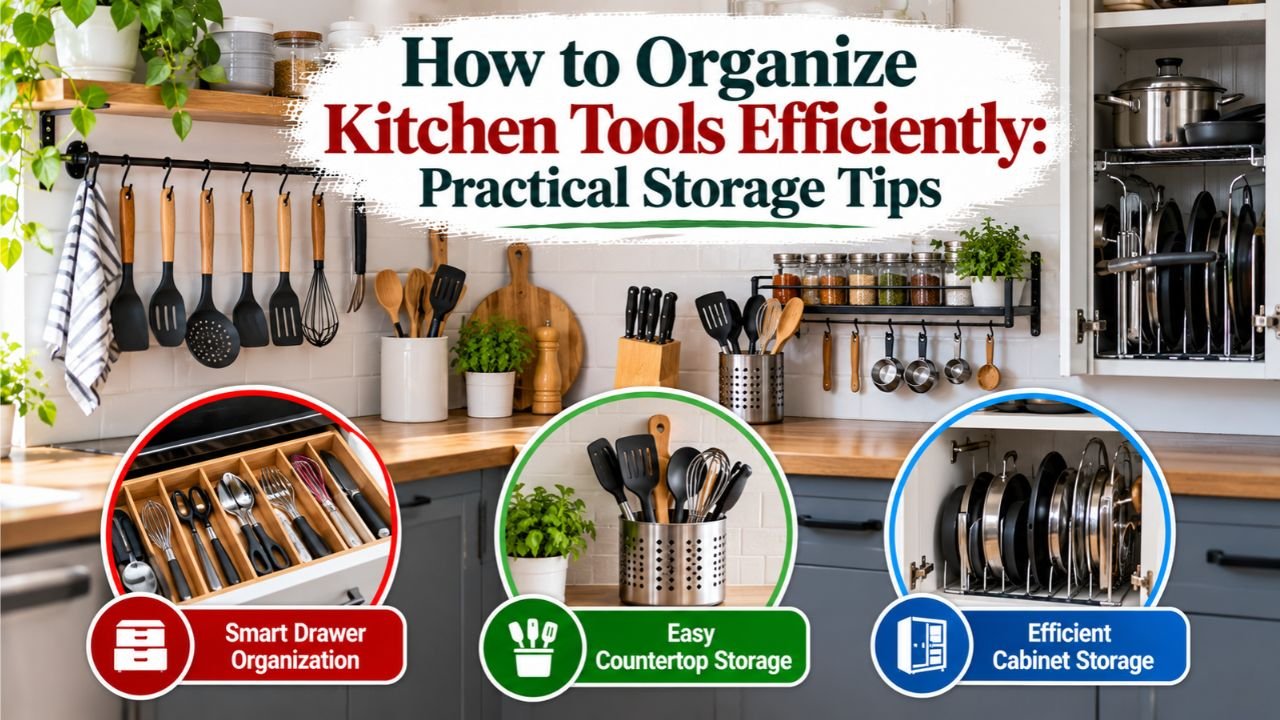
How to Organize Kitchen Tools Efficiently: Practical Storage Tips
Organizing kitchen tools efficiently starts with grouping similar utensils, keeping frequently used items close to where you cook, and assigning every tool a practical storage spot. The goal is to make cooking easier without filling drawers, cabinets, or countertops with unnecessary clutter.
A well-organized kitchen lets you grab a spatula, knife, measuring spoon, or mixing bowl without searching through several drawers. You don’t need expensive organizers or a large kitchen to make that happen.
With a few changes to your storage layout, you can create an efficient kitchen setup that matches your cooking habits, makes better use of available space, and stays organized.
How to Organize Kitchen Tools Efficiently: Step-by-Step
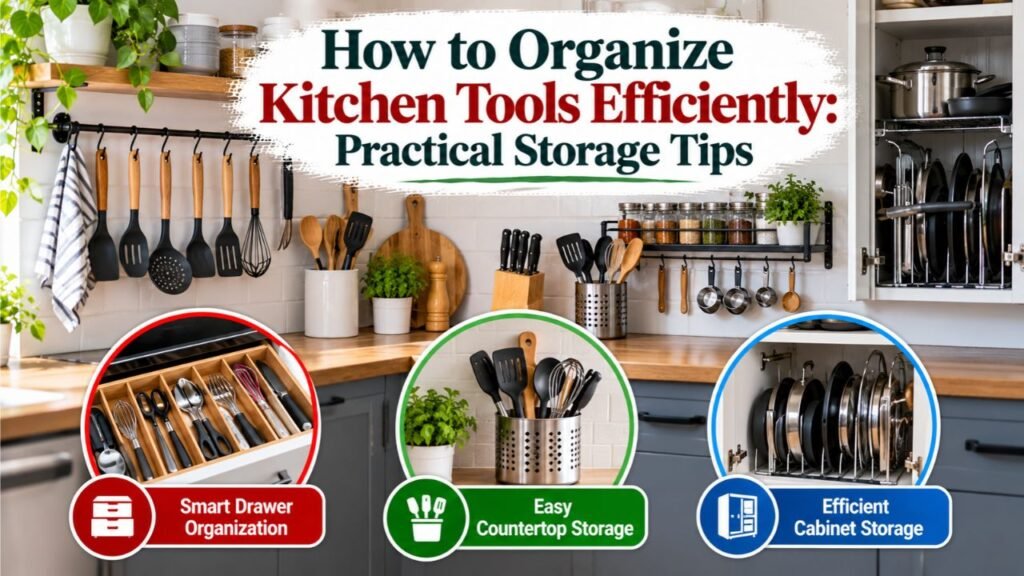
The easiest way to organize kitchen tools is to start with what you already own rather than buying new storage containers. Sorting, reducing clutter, and assigning practical locations will help you build a system that works for everyday cooking.
Step 1: Empty Your Kitchen Tool Drawers and Cabinets
Start by removing the utensils, gadgets, and cooking equipment from the storage areas you want to reorganize.
Place everything on a clean countertop or table where you can see it. Include commonly forgotten items such as measuring spoons, peelers, can openers, kitchen scissors, and appliance attachments.
As you empty each area:
- Remove crumbs and debris from drawers.
- Wipe cabinet shelves and drawer interiors.
- Check utensils for damage, rust, or loose handles.
- Identify duplicate tools.
- Look for equipment that hasn’t been used recently.
Working through one storage area at a time can make the project easier if your kitchen is particularly cluttered.
Important: Don’t purchase drawer organizers before sorting your tools. You may discover that you need fewer dividers or containers than expected.
Step 2: Sort Kitchen Tools by Their Functions
Once everything is visible, divide the tools into categories based on what they actually do.
Useful categories include:
- Food preparation tools: Knives, vegetable peelers, graters, chopping boards, and kitchen scissors.
- Cooking utensils: Spatulas, ladles, wooden spoons, tongs, and turners.
- Measuring tools: Measuring cups, measuring spoons, food scales, and measuring jugs.
- Baking equipment: Whisks, rolling pins, pastry brushes, dough scrapers, and cookie cutters.
- Serving tools: Serving spoons, salad servers, cake servers, and carving utensils.
- Specialty gadgets: Garlic presses, citrus juicers, apple corers, and other single-purpose tools.
Grouping by function makes it easier to decide which tools should share storage space.
However, similar tools don’t always belong together. A spatula used for daily stovetop cooking may be more convenient near the stove than inside a drawer containing occasional baking utensils.
Step 3: Separate Everyday Tools From Rarely Used Equipment
Not every kitchen tool deserves the same amount of accessible storage space.
Divide the tools into three practical groups:
- Daily-use tools: Keep these in drawers, containers, or cabinets within comfortable reach of the main cooking area.
- Occasionally used tools: Store these in secondary drawers or cabinets where they remain easy to retrieve.
- Rarely used tools: Move these to upper cabinets, less accessible shelves, or another suitable storage area.
For example, a vegetable peeler and chef’s knife might be used almost every day, while a pasta maker or cookie press may only come out occasionally.
Give the frequently used tools priority rather than allowing specialty gadgets to occupy the most convenient spaces.
Step 4: Remove Duplicates and Unnecessary Gadgets
Kitchen drawers often become overcrowded because they contain multiple versions of tools that perform the same job.
Check whether you genuinely need:
- Several can openers
- Multiple identical peelers
- Extra measuring spoon sets
- Damaged spatulas
- Unused promotional kitchen gadgets
- Specialty tools for meals you no longer prepare
You don’t have to eliminate every duplicate. Two spatulas or several pairs of tongs may be useful when preparing multiple dishes.
Keep the tools that serve a clear purpose and donate or recycle usable extras where appropriate. Dispose of damaged equipment that cannot be used safely.
Step 5: Measure Your Drawers and Available Storage Space
Before adding dividers, baskets, or racks, measure the actual usable storage space.
For drawers, check the interior width, front-to-back depth, and usable height.
Also measure your longest utensils. A large whisk or ladle may not fit comfortably inside a standard silverware tray.
Pay attention to:
- Drawer slides and internal hardware
- Cabinet door clearance
- Shelf height
- Shelf depth
- Available wall space
- Countertop clearance beneath upper cabinets
Choose organizers that fit without interfering with drawer movement or cabinet doors.
Step 6: Assign Every Tool a Permanent Storage Location
Give each category a consistent storage location based on how you use it.
For example, keep food preparation tools near your main cutting area and cooking utensils near the stove.
Make sure you can remove and return commonly used equipment without shifting several other items.
After arranging everything, use the kitchen normally for a few days. If a tool feels inconvenient to reach, move it to a more practical location.
A useful organization system should adapt to your daily cooking routine rather than force you to change how you cook.
Create Kitchen Tool Storage Zones Around Cooking Tasks
Organizing by kitchen activity is often more effective than storing equipment wherever it happens to fit.
North Dakota State University Extension’s kitchen organization guidance recommends keeping supplies close to where they are used and dividing the kitchen into practical preparation, cooking, and cleanup areas.
You can apply this approach without changing your cabinets or kitchen layout.
Keep Food Preparation Tools Near the Main Counter
Your preparation zone should contain the tools needed for chopping, peeling, slicing, measuring, and mixing ingredients.
A practical setup might include:
- Cutting boards stored vertically in a nearby cabinet
- Knives secured in a dedicated block, rack, or drawer insert
- Vegetable peelers and graters in a shallow drawer
- Measuring cups and spoons in a nearby compartment
- Mixing bowls in an accessible lower cabinet
If you usually chop vegetables beside the sink, that counter becomes your main food preparation area.
There is no reason to store your cutting boards on the opposite side of the kitchen simply because an empty cabinet is available there.
Arrange Cooking Utensils Close to the Stove
The cooking zone should prioritize tools needed while food is heating.
Spatulas, ladles, wooden spoons, heat-resistant turners, and cooking tongs are common examples.
A nearby utensil drawer can provide convenient storage without adding countertop clutter.
Alternatively, a compact countertop utensil holder works well when drawer space is limited.
Keep the holder away from burner flames, hot surfaces, and areas exposed to excessive grease.
Store oven mitts or heat-resistant pot holders within easy reach, but never where they could contact a hot burner.
Give Baking Tools Their Own Storage Area
Baking equipment is easier to manage when mixing, measuring, and dough preparation tools are stored together.
Consider keeping:
- Rolling pins in a deep drawer or cabinet
- Pastry brushes in a small divided container
- Cookie cutters in a labeled box
- Baking sheets in vertical dividers
- Cake decorating supplies in a dedicated bin
- Mixing bowls nested by size
If you rarely bake, this collection doesn’t need to occupy a prime cooking drawer.
If baking is a frequent activity, place the tools near the counter where you usually measure ingredients and work with dough.
Place Cleanup and Serving Equipment Where Needed
Cleaning tools work best near the sink, while serving utensils may be more convenient near plates and dinnerware.
Keep dish brushes, cleaning cloths, and suitable drying equipment close to the sink.
Place serving spoons, salad servers, and other frequently used serving pieces in a drawer near your dishes or serving area.
Keep household cleaning chemicals in secure, separate storage away from food and food-contact utensils.
The goal is to create clear storage locations that make both cooking and cleanup straightforward.
Organize Kitchen Utensil Drawers Without Wasting Space
Kitchen drawers are useful for smaller tools because they keep equipment contained, protected, and out of sight.
However, a poorly arranged drawer can become a collection of overlapping utensils that are difficult to retrieve.
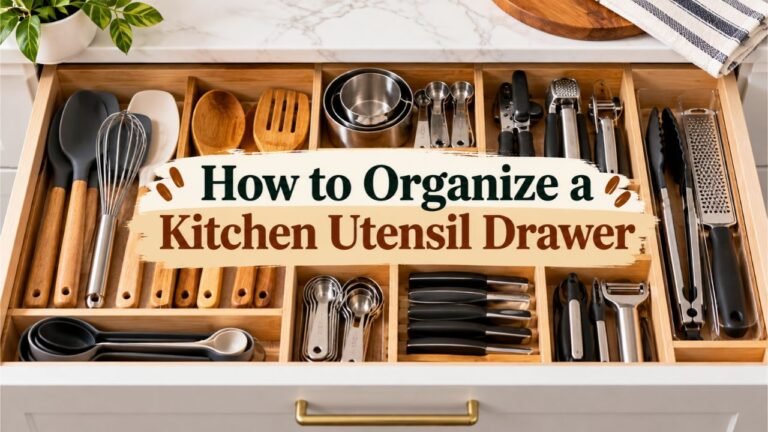
Use Adjustable Drawer Dividers for Different Tool Sizes
Adjustable dividers create separate compartments for utensils with different shapes and lengths.
For example, a single drawer could contain:
- One long section for spatulas and wooden spoons
- One compartment for whisks and tongs
- One smaller section for peelers and can openers
- One narrow compartment for measuring spoons
Expandable dividers are particularly useful when standard organizers don’t match your drawer dimensions.
Choose compartments according to your actual tools rather than trying to fit everything into a fixed layout.
Arrange Long Utensils in a Single Layer When Possible
Long-handled kitchen tools often become tangled when they are stacked in a deep drawer.
Arrange spatulas, ladles, and tongs side by side whenever space allows.
Place similar tools in the same direction so their handles are easy to identify and grab.
If stacking is unavoidable, keep everyday tools on top and less frequently used pieces underneath.
Avoid filling a drawer so tightly that utensils catch on the drawer frame or prevent it from closing properly.
Use Small Containers for Loose Kitchen Gadgets
Small gadgets can easily disappear beneath larger cooking utensils.
Use compact trays or containers for items such as:
- Bottle openers
- Vegetable peelers
- Measuring spoons
- Small pastry tools
- Reusable food clips
- Kitchen thermometers in protective cases
Removable trays are especially practical because you can lift them out for cleaning.
You can reuse clean, sturdy containers if they fit properly and don’t have sharp edges.
Store Kitchen Knives in Protected Compartments
Sharp knives should not be placed loose among other kitchen utensils.
Use a dedicated knife block, an in-drawer knife organizer, or individual blade guards designed for the knives.
This protects the cutting edges and reduces the chance of accidentally touching an exposed blade.
Keep knife storage secure and inaccessible to young children.
Use Kitchen Cabinets for Bulky Tools and Equipment
Not every kitchen tool belongs in a drawer. Cabinets provide better storage for bulky, heavy, or irregularly shaped equipment.
The key is to arrange these items so that you don’t have to remove several pieces to access one tool.
Keep Heavy Kitchen Tools in Lower Cabinets
Large mixing bowls, food processors, heavy cookware, and countertop appliances are generally easier to lift from lower cabinets or sturdy pull-out shelves.
Avoid placing heavy appliances on high shelves where retrieving them requires lifting above shoulder level.
If you use a food processor regularly, consider giving its base and accessories a dedicated cabinet space near your preparation area.
Store attachments together so blades, discs, and lids don’t become separated.
Store Cutting Boards and Baking Trays Vertically
Flat kitchen equipment often wastes cabinet space when stacked horizontally.
Vertical cabinet dividers can hold:
- Cutting boards
- Baking sheets
- Muffin pans
- Cooling racks
- Serving trays
- Pizza pans
Storing these items upright makes individual pieces easier to remove.
Use a stable organizer that supports their weight and keeps them from tipping when another item is removed.
Use Pull-Out Baskets for Deep Cabinets
Deep cabinets can be inconvenient when smaller equipment gets pushed to the back.
A pull-out basket or sliding shelf allows you to bring stored tools forward instead of reaching into the cabinet.
These organizers work particularly well for mixing bowls, appliance accessories, and medium-sized gadgets.
Check the cabinet dimensions, shelf strength, and hardware weight capacity before installing a pull-out system.
For a budget-friendly alternative, use a removable bin that fits comfortably on the shelf.
Make Better Use of Small Kitchen Storage Spaces
A small kitchen may have limited drawer space, narrow cabinets, and very little available countertop.
Instead of trying to fit every tool into the existing drawers, use vertical surfaces and carefully selected storage accessories.
Hang Lightweight Tools on Wall Hooks or Rails
Wall-mounted hooks or utensil rails can free up drawer space.
Suitable items include lightweight:
- Cooking spoons
- Spatulas
- Measuring cups
- Small strainers
- Lightweight whisks
Choose sturdy mounting hardware appropriate for the wall and the combined weight of the tools.
Keep hanging utensils away from open flames and locations where they could interfere with cooking or movement.
Add Storage to the Inside of Cabinet Doors
Cabinet door interiors can hold lightweight tools when suitable organizers are installed.
Slim racks or hooks may work for measuring spoons, small accessories, or lightweight kitchen items.
Before installing anything, check that the organizer won’t interfere with interior shelves, hinges, or stored equipment.
Avoid adding heavy items to cabinet doors unless the hardware and door construction are designed to support them.
Use Countertop Utensil Holders Selectively
A countertop holder is helpful when your most-used cooking utensils don’t fit into a convenient drawer.
However, an oversized collection of holders can leave very little space for preparing food.
Choose one stable, easy-to-clean container for the utensils you reach for most frequently.
Move occasional-use tools into drawers or cabinets instead of adding more containers to the countertop.
Take Advantage of Unused Cabinet Height
Tall cabinets may contain significant empty space above shorter items.
Shelf risers and stackable organizers can create additional storage levels for lightweight equipment.
Avoid unstable stacks or arrangements that require you to remove several objects before reaching the one you need.
For heavy items, accessible lower storage is usually more practical than maximizing vertical capacity.
Best Storage Locations for Different Kitchen Tools
Different kitchen tools need different storage arrangements depending on their size, shape, weight, and frequency of use.
The following table provides a practical starting point.
| Kitchen Tool | Recommended Storage | Main Advantage |
| Spatulas and cooking spoons | Divided drawer or countertop holder | Easy access during cooking |
| Knives | Knife block or protected drawer insert | Protects blades and hands |
| Measuring cups and spoons | Small drawer organizer or dedicated hook rail | Keeps matching sets together |
| Cutting boards | Vertical cabinet rack | Easy removal and drying access |
| Whisks and tongs | Long drawer compartment | Reduces tangling |
| Mixing bowls | Lower cabinet, nested by size | Saves space |
| Baking sheets | Vertical cabinet divider | Prevents awkward stacking |
| Food processor attachments | Dedicated labeled container | Keeps accessories together |
| Small specialty gadgets | Divided bin or secondary drawer | Prevents loose-item clutter |
| Heavy appliances | Sturdy lower cabinet or pull-out shelf | Easier, safer retrieval |
These recommendations are flexible. Your kitchen’s layout and daily routine should determine the final placement.
Keep Kitchen Tools Clean and Safe During Storage
Efficient organization also involves protecting equipment from moisture, damage, and food contamination.
Even a tidy drawer can become unsuitable for food-contact tools if items are stored dirty or damp.
Clean Utensils Before Returning Them to Storage
Wash utensils and food-contact equipment after use, following any material-specific care instructions.
According to FoodSafety.gov’s official food safety guidance, cutting boards, utensils, dishes, and food preparation surfaces should be washed with hot, soapy water, particularly after contact with raw meat, poultry, seafood, or eggs.
Keep separate cutting boards available for raw animal foods and foods that will be eaten without further cooking.
Tools that contact raw ingredients should be properly cleaned before they are used for cooked or ready-to-eat food.
Dry Kitchen Equipment Before Putting It Away
Moisture trapped inside drawers or closed containers can create unpleasant odors and contribute to material deterioration.
Allow utensils to dry thoroughly before returning them to storage.
Pay particular attention to:
- Wooden spoons and spatulas
- Knife handles and blade joints
- Food processor attachments
- Box graters
- Measuring cups
- Tools with seams or enclosed spaces
Wooden utensils should not be stored while visibly damp. Follow the manufacturer’s cleaning and drying directions for wood, silicone, plastic, and metal tools.
Protect Delicate and Sharp Equipment
Some kitchen tools require more protection than ordinary cooking utensils.
Keep exposed blades in protective storage rather than loose drawers. Store delicate thermometer probes in their cases, and avoid placing heavy objects on fragile measuring equipment.
Remove damaged utensils from service if they have cracked handles, loose components, sharp broken edges, or deteriorated food-contact surfaces.
Keeping equipment in suitable storage locations can help prevent avoidable damage and make it easier to inspect.
Kitchen Tool Organization Mistakes to Avoid
Several storage habits can make an otherwise organized kitchen inconvenient to use.
Storing Every Utensil in One Drawer
Combining spatulas, knives, measuring spoons, gadgets, and serving tools in one crowded drawer makes individual items difficult to find.
Separate tools by function and location whenever storage space allows.
Even two or three clearly defined compartments can improve a crowded drawer.
Keeping Rarely Used Gadgets in Prime Storage
A specialty appliance used a few times a year doesn’t need the same convenient location as your everyday cooking equipment.
Move occasional-use gadgets to secondary storage and reserve accessible drawers for regularly used tools.
Buying Organizers Before Measuring
An attractive divider may be useless if it doesn’t fit your drawer or accommodate your longest utensils.
Measure both the storage area and the tools before buying organizational accessories.
Look for flexible layouts that can adapt if your kitchen equipment changes.
Overloading Wall Hooks and Cabinet Organizers
Wall-mounted storage should be selected according to the strength of its mounting surface and hardware.
Overloading hooks, rails, or cabinet door organizers can cause them to loosen or fail.
Follow the hardware manufacturer’s installation instructions and weight limits.
Leaving Too Many Tools on the Countertop
Keeping everything visible may seem convenient, but excessive countertop storage can reduce the space available for chopping, mixing, and preparing meals.
Keep only the tools you use regularly on display.
Store the rest in suitable drawers, racks, or cabinets.
How to Maintain an Efficient Kitchen Tool Organization System
A storage layout only remains useful when tools consistently return to their assigned locations.
You don’t need a complicated maintenance routine.
A few practical habits are usually enough.
Return Tools to Their Assigned Locations
After washing and drying utensils, return them to the same drawer, holder, or cabinet.
Avoid placing equipment in whichever empty space happens to be closest.
If several people use the kitchen, make the layout straightforward enough that everyone can identify where tools belong.
Review Overcrowded Drawers Regularly
A drawer that becomes difficult to close or contains several unnecessary duplicates needs attention.
Check whether newly purchased gadgets have displaced frequently used equipment.
Remove damaged tools, donate usable extras, and adjust dividers when necessary.
A quick review every few months can be helpful, but the ideal schedule depends on how quickly your kitchen equipment collection changes.
Adjust Storage When Your Cooking Habits Change
Your kitchen organization should reflect the meals you actually prepare.
If you begin baking regularly, move baking tools to a more accessible location.
If a countertop appliance is no longer used frequently, consider moving it into a cabinet.
The most efficient arrangement is not necessarily the one with the fewest visible objects. It is the arrangement that makes your daily tasks easier while keeping the kitchen practical and safe.
Conclusion
Learning how to organize kitchen tools efficiently is mainly about placing the right equipment in the right locations.
Start by removing unnecessary items, grouping tools by function, and identifying what you use most often. Keep food preparation equipment near your main counter, cooking utensils near the stove, and bulky or occasional-use tools in suitable cabinets.
Drawer dividers, vertical racks, and compact storage containers can help, but they work best when chosen for a specific storage problem.
Focus on accessibility, safety, and consistent storage habits rather than trying to make every drawer look perfectly arranged.
FAQs About How to Organize Kitchen Tools Efficiently
Should Kitchen Utensils Be Stored in Drawers or on the Counter?
Both options work well. Drawers protect utensils from dust and countertop splashes, while a countertop holder provides quick access to frequently used cooking tools.
Choose a drawer when you want to keep counters clear. Use a holder for a small collection of everyday utensils if it can be placed safely away from heat and food splashes.
How Can I Organize Kitchen Tools Without Buying Organizers?
Start by removing unused equipment and assigning specific drawers or cabinet areas to different tool categories.
You can reuse clean, sturdy containers to separate smaller gadgets. Nesting mixing bowls and storing baking trays upright in a stable existing compartment can also help reduce clutter.
Is It Better to Store Wooden Spoons Upright?
Wooden spoons can be stored upright in a clean holder or laid flat in a drawer. Either arrangement is suitable when the utensils are thoroughly clean and dry.
For upright storage, choose a holder that allows easy removal and doesn’t trap moisture. Keep it away from excessive heat and grease.
Can Kitchen Tools Be Stored Above the Stove?
Some kitchens have cabinets above the stove, but that doesn’t make the area ideal for frequently used utensils.
Heat, steam, grease, and the need to reach over cooking equipment can make this location inconvenient or unsafe. Avoid hanging combustible tools or placing storage accessories where they could contact burners or interfere with cooking.
How Often Should I Declutter Kitchen Utensils?
Review your kitchen tools whenever drawers become crowded, equipment becomes difficult to locate, or your cooking habits change.
A more thorough check every few months can help identify unnecessary duplicates, damaged tools, and equipment that deserves a different storage location. The goal is to keep the kitchen functional, not to follow a rigid decluttering schedule.