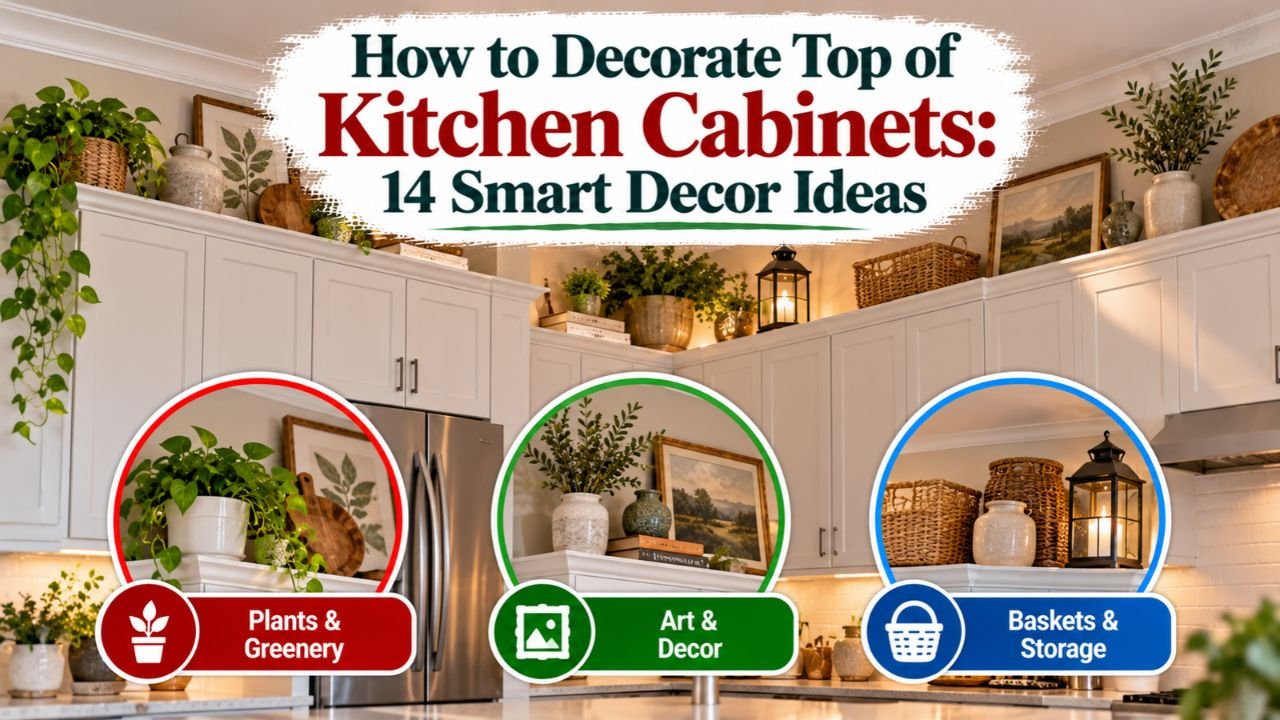
How to Decorate Top of Kitchen Cabinets: 14 Smart Decor Ideas
To decorate the top of kitchen cabinets, choose a few large, coordinated pieces, such as woven baskets, ceramic vases, framed artwork, or greenery, and leave some open space between them. Match the decorations to the height of the gap and your kitchen’s overall style rather than filling every available inch.
The space between upper cabinets and the ceiling can look unfinished, especially in kitchens with standard-height wall cabinets. However, adding too many small objects can make the room look cluttered instead of attractive.
The best decorations are visible from floor level, reasonably easy to clean, and suitable for the kitchen environment. This matters because dust and cooking grease can accumulate on objects stored above cabinets.
You also don’t need to decorate every cabinet. In some kitchens, simple crown molding or an empty, freshly painted space looks better than a crowded display.
In this article, I explain how to decorate top of kitchen cabinets step by step, with 14 practical ideas for modern, farmhouse, traditional, and small kitchens. You’ll also learn how to arrange decorations, choose the right sizes and colors, use the space for storage, and prevent common cleaning and safety problems.
Read More: what to put on top of kitchen cabinets modern
How to Decorate Top of Kitchen Cabinets Step by Step
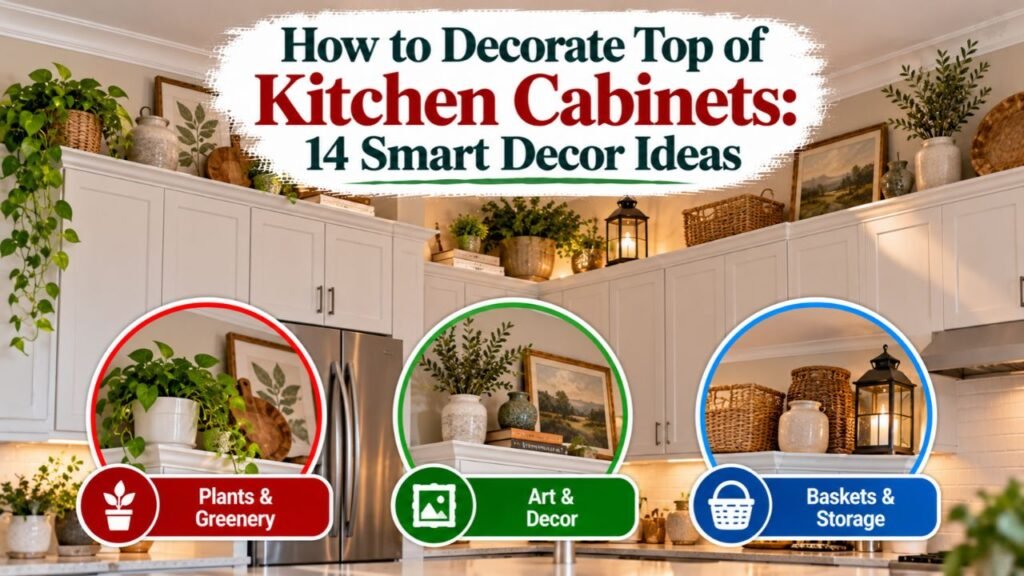
Decorating above kitchen cabinets works best when you plan the arrangement before buying accessories.
The following steps help create a balanced display without making the kitchen feel overcrowded.
Step 1: Measure the Space Above Your Cabinets
Start by measuring the distance between the cabinet tops and the ceiling.
Check the height at several locations because ceilings and cabinet installations aren’t always perfectly level.
Also measure the length and usable depth of the cabinet tops.
These dimensions determine which decorations will fit.
For example, a 6-inch gap generally isn’t suitable for large decorative vases. A 20-inch gap can accommodate much taller accessories.
Make sure decorations have clearance from the ceiling, wall fixtures, vents, and other equipment.
Practical Tip: Measure the available depth before buying baskets or planters. A decoration shouldn’t extend dangerously beyond the cabinet’s front edge.
Step 2: Clean the Cabinet Tops
Before decorating, remove accumulated dust and grease.
Use a soft microfiber cloth and a cleaner suitable for your cabinet’s finish.
Some surfaces can be damaged by excessive moisture or aggressive cleaning chemicals.
Pay particular attention to cabinets near the stove, where airborne cooking grease may settle.
Allow the surfaces to dry before placing decorations.
Inspect the cabinet tops to confirm they are stable and suitable for displaying lightweight accessories.
Step 3: Choose a Decorating Style
Select an overall style that complements the existing kitchen.
Popular options include:
- Modern and minimalist
- Farmhouse
- Traditional
- Rustic
- Coastal
- Bohemian
- Transitional
You don’t need to follow one style rigidly.
However, repeating a few colors, shapes, or materials creates a more coordinated appearance.
For example, a modern kitchen with white cabinets and black hardware might look attractive with black ceramic vases and natural wooden accents.
A farmhouse kitchen may work better with woven baskets, pottery, and restrained greenery.
Step 4: Choose One Main Decorative Element
Instead of purchasing many unrelated items, start with one main element.
This could be:
- A large ceramic vase
- A group of woven baskets
- A framed print
- A decorative wooden bowl
- A substantial plant arrangement
The main object establishes the display’s size, color, and character.
Additional pieces should support it rather than compete for attention.
Choose objects large enough to be noticeable from a normal standing position.
Very small decorations often disappear visually above high cabinets.
Step 5: Arrange Items at Different Heights
An attractive display usually has some variation in height.
For example, you might combine:
- One tall vase
- One medium basket
- One smaller decorative bowl
This creates visual interest without requiring a large number of items.
Groups of three are a simple starting point, but they aren’t a strict design rule.
The arrangement should look balanced from the main viewing areas of the kitchen.
Avoid making every section identical unless you’re intentionally creating a symmetrical design.
Step 6: Leave Open Space Between Groups
Don’t cover the entire cabinet top with decorations.
A few clear spaces help individual objects stand out.
For a long cabinet run, try creating two or three separated arrangements rather than one uninterrupted row.
This also makes cleaning easier.
If your kitchen already contains patterned backsplash tiles, open shelves, or colorful countertops, use fewer decorations above the cabinets.
Step 7: Check Stability and Safety
Before finishing, confirm that every item is stable.
Avoid placing heavy, breakable, or unstable objects near exposed edges.
Keep decorations away from heat sources, exhaust openings, sprinkler heads, and electrical equipment.
Use appropriate mounting hardware for artwork, shelves, or lighting that requires attachment.
Don’t assume that the top of a wall cabinet can safely support heavy storage.
Check its construction and installation limitations.
Step 8: View the Arrangement From Different Angles
Step back and look at the display from the kitchen entrance, dining area, and main working spaces.
Ask yourself:
- Do the decorations look balanced?
- Are the objects large enough to see?
- Is the color scheme consistent?
- Does the display make the room feel crowded?
- Is everything easy to clean and maintain?
Remove anything that seems unnecessary.
Often, taking away one or two pieces improves the overall appearance.
Key Takeaway: Measure first, choose one decorating direction, and build a few well-spaced arrangements. The goal is to make the cabinet tops look intentional rather than completely filled.
14 Best Ideas for Decorating the Top of Kitchen Cabinets
The best decorations depend on the available space, cabinet style, and how much maintenance you’re comfortable doing.
The following ideas work in many kitchens and can be adapted to different budgets.
1. Display Large Ceramic Vases
Ceramic vases are one of the simplest ways to decorate above kitchen cabinets.
They introduce shape, color, and texture without requiring many accessories.
Choose two or three vases with complementary finishes.
For example:
- One tall matte-white vase
- One medium textured beige vase
- One small charcoal ceramic pot
Arrange them with a little space between each piece.
Avoid using very small vases that aren’t noticeable from floor level.
For a modern kitchen, simple cylindrical or sculptural shapes work well.
For a traditional kitchen, consider pottery with subtle patterns or classic rounded forms.
If the vases are breakable, use appropriate securement and keep them well back from the cabinet edge.
2. Arrange Woven Baskets
Woven baskets add natural texture and warmth.
They’re especially attractive above white, cream, gray, or muted green cabinets.
Natural materials such as rattan, wicker, and seagrass can create a softer appearance in a kitchen dominated by hard surfaces.
Choose a few baskets with similar colors but slightly different shapes.
Low, wide baskets are useful when the gap is limited.
Taller baskets can work in kitchens with higher ceilings.
Lidded baskets can also conceal lightweight, infrequently used items.
Avoid using open, loosely woven baskets immediately above cooking areas where grease can become trapped in the fibers.
3. Add Greenery Above the Cabinets
Greenery can make the upper part of a kitchen feel more inviting.
Trailing plants are particularly effective because their leaves soften the straight horizontal lines of cabinet tops.
Options include:
- Pothos
- Heartleaf philodendron
- Certain trailing artificial plants
- Compact foliage plants in lightweight pots
Real plants need suitable light, watering, and drainage.
Don’t place a live plant above cabinets if reaching it safely for watering is difficult.
Use a stable, leakproof saucer or cachepot to protect cabinet surfaces.
High-quality artificial greenery may be more practical in darker or harder-to-reach locations.
Choose realistic-looking foliage rather than filling the entire cabinet run with artificial vines.
4. Lean Framed Artwork Against the Wall
Framed artwork adds personality to the space above cabinets.
It works particularly well when there is enough height for the artwork to be visible.
Suitable subjects include:
- Botanical prints
- Abstract artwork
- Vintage food illustrations
- Landscapes
- Simple graphic designs
Select frames that coordinate with other finishes in the kitchen.
For example, black frames can complement black cabinet handles.
Light wood frames pair well with natural countertops and woven accessories.
Use appropriate restraints or mounting hardware so the artwork cannot slip or fall.
Lightweight acrylic-front frames may be preferable to heavy glass frames in elevated locations.
5. Use Decorative Wooden Cutting Boards
Wooden cutting boards introduce warmth and a practical kitchen-related element.
Choose boards with attractive wood grain and varied shapes.
Round, rectangular, and paddle-shaped boards can create a layered arrangement.
These should be decorative boards rather than everyday cutting boards that require frequent access.
Keep them away from cooking grease, steam, and excessive heat.
If you use old boards, clean and dry them before displaying them.
Don’t position them where they could fall into cooking equipment.
6. Display Decorative Bowls and Platters
Large serving bowls and decorative platters can create an understated arrangement.
They work especially well in traditional and transitional kitchens.
Choose a consistent material or finish, such as:
- White ceramic
- Blue-and-white porcelain
- Natural wood
- Matte stoneware
- Neutral-colored pottery
Wide, shallow bowls can be useful for lower gaps.
A large platter can also provide a focal point when displayed securely on an appropriate stand.
Avoid unstable plate stands or heavy breakable pieces that could fall from the cabinet tops.
7. Showcase a Small Vintage Collection
A carefully selected vintage collection gives the kitchen a personal character.
Examples include:
- Vintage ceramic pitchers
- Antique-style kitchen crocks
- Decorative copper vessels
- Old-fashioned enamelware
- Traditional pottery
Keep the collection focused.
Displaying three similar pitchers is often more cohesive than combining unrelated antiques across the entire cabinet run.
Older kitchen items may have sharp edges, deteriorating finishes, or unknown coatings.
Use them for display rather than food service unless they’re known to be food-safe.
8. Use Matching Storage Bins
The space above cabinets can also hold lightweight items that aren’t needed frequently.
Lidded storage bins provide a cleaner appearance than exposed packaging.
For example, you might store:
- Seasonal table linens
- Lightweight party decorations
- Extra placemats
- Infrequently used decorative accessories
- Lightweight seasonal kitchen items
Choose matching bins in a neutral color.
Keep them within the cabinet top’s supported area.
Avoid storing heavy appliances, unstable stacks, or frequently needed items in a location that requires climbing to reach.
9. Arrange Decorative Cookbooks
Cookbooks can add color and character to an open space above kitchen cabinets.
However, they should be used selectively.
Choose a few books with attractive covers or coordinated spine colors.
Display them vertically with suitable bookends or horizontally in a small stable stack.
Keep them away from cooking grease and steam.
Books you use every day should remain in an accessible location.
Above-cabinet cookbooks work best as a decorative collection rather than essential cooking references.
10. Add Wooden Trays or Decorative Risers
Decorative trays can help organize smaller accessories into one visual group.
A shallow wooden tray might hold a small vase and another lightweight object.
This creates a defined arrangement instead of several items scattered across the cabinet top.
Low risers can introduce some height where the available space permits.
However, don’t create unstable stacks or place heavy items on lightweight platforms.
Select broad, stable bases that fit entirely on the cabinet surface.
11. Install Warm LED Accent Lighting
Lighting can make the space above the cabinets appear more finished without adding visible clutter.
Warm LED strip lights are a popular choice.
They can produce a soft glow across the wall or ceiling.
In Martha Stewart’s 2026 guide to using space above kitchen cabinets, interior designers recommend concealed lighting and warm white color temperatures around 2700K–3000K for an inviting appearance.
Choose a lighting system suitable for the installation location.
Keep wiring properly routed and follow the manufacturer’s electrical and mounting instructions.
Use a qualified electrician for hardwired electrical work.
Don’t conceal unsuitable cords in tight spaces or place lighting too close to combustible materials.
12. Create a Simple Seasonal Display
Seasonal decorations can refresh the kitchen without requiring a permanent redesign.
Choose a few pieces that match the season while retaining the kitchen’s overall color palette.
For example:
| Season | Decorating Ideas |
| Spring | Small floral arrangements, light pottery, soft greenery |
| Summer | Woven baskets, coastal accents, light-colored ceramics |
| Fall | Muted orange pottery, decorative pumpkins, wooden accents |
| Winter | Evergreen-inspired arrangements, neutral seasonal ornaments, warm lighting |
Keep decorations proportional to the available space.
Use battery-powered LED lights rather than open-flame candles.
Avoid loose dried greenery, paper, or fabric decorations near cooking heat.
Seasonal displays are most effective when they remain simple and coordinated.
13. Decorate the Wall Above Cabinets With Wallpaper or Paint
Sometimes the best solution is to decorate the wall instead of placing objects on top of the cabinets.
Wallpaper can add pattern and color to an otherwise empty gap.
Suitable options include:
- Subtle botanical patterns
- Small geometric prints
- Textured neutral wallpaper
- Soft stripes
- A coordinated accent paint color
This method is particularly useful when the gap is too small for decorative objects.
Paint the area in a color that complements the cabinets, backsplash, or kitchen walls.
Avoid very busy wallpaper if the kitchen already has strong patterns.
For rental homes, suitable removable wallpaper may be an option if permitted by the lease and compatible with the wall finish.
14. Add Crown Molding or a Cabinet-Top Extension
If you prefer a clean, built-in appearance, consider finishing the space with molding rather than individual objects.
Crown molding can visually connect upper cabinets with the ceiling.
For larger gaps, a properly designed decorative cabinet extension or soffit can create a more integrated appearance.
HGTV’s 2026 above-kitchen-cabinet decorating ideas include architectural trim and lighting treatments that make the area above cabinets feel intentional.
Choose molding that matches the cabinet style.
A simple flat trim may suit a modern kitchen, while more detailed crown molding may complement traditional cabinetry.
If the project involves constructing a soffit or cabinet extension, consider professional installation.
Do not block ventilation, wiring access, sprinklers, or other building systems.
Key Takeaway: Pottery, baskets, greenery, and artwork are versatile choices for taller gaps. Lighting, wallpaper, and molding work well when you want a more finished appearance without placing many objects above the cabinets.
How to Decorate Kitchen Cabinets Based on the Space Above Them
The distance between the cabinet tops and ceiling is one of the most important factors in choosing decorations.
A piece that looks balanced in a tall kitchen may appear crowded in a low gap.
Decorating Cabinets With Less Than 6 Inches of Space
Very small gaps are usually difficult to decorate with objects.
Even a short basket or vase may almost touch the ceiling.
For these spaces, consider:
- Leaving the area empty
- Painting the wall to match the cabinets
- Installing suitable crown molding
- Using a simple trim treatment
Avoid forcing small decorative objects into the gap merely to fill it.
An empty, clean space can look more attractive than crowded decorations.
Decorating Cabinets With 6–12 Inches of Space
A low-to-medium gap can accommodate shallow decorative pieces.
Good choices include:
- Low woven baskets
- Short ceramic bowls
- Small horizontal arrangements
- A simple wall-color treatment
- Concealed lighting where suitable
Keep the decorations below the ceiling line so they have enough room to be visible.
Avoid tall plants or large upright artwork.
Decorating Cabinets With 12–18 Inches of Space
This height provides more flexibility.
You can use:
- Medium ceramic vases
- Layered frames
- Decorative pitchers
- Compact greenery
- Coordinated storage baskets
Try combining two or three items of different heights.
Don’t fill every section of the cabinet top.
Decorating Cabinets With More Than 18 Inches of Space
Taller gaps can accommodate larger-scale decoration.
A substantial vase, oversized framed print, or coordinated collection may look more balanced than many small accessories.
The extra height can also support architectural treatments such as a decorative shelf or cabinetry extension, provided the structure is properly designed and installed.
If the cabinets sit far below a high ceiling, focus on making the decorations visible from floor level.
Very small items can get lost in the open space.
Above-Cabinet Decorating Guide by Gap Height
| Space Above Cabinets | Recommended Approach |
| Under 6 inches | Leave empty, paint, or use trim |
| 6–12 inches | Low baskets, shallow pottery, subtle lighting |
| 12–18 inches | Vases, artwork, greenery, grouped accessories |
| Over 18 inches | Larger statement pieces, architectural features, layered arrangements |
| No gap | Keep the full-height cabinet finish clean |
These are practical styling guidelines, not construction requirements.
Measure the actual space and consider the objects’ proportions before purchasing.
Key Takeaway: A small gap often looks better with paint or trim, while a tall gap benefits from fewer, larger decorations that can be seen clearly from floor level.
How to Decorate Above Kitchen Cabinets for Different Kitchen Styles
The same decorations won’t necessarily work in every kitchen.
Use existing cabinet finishes, countertop colors, lighting, and hardware to guide your choices.
Modern Kitchen Cabinet Top Decor
Modern kitchens generally benefit from simple lines and limited decoration.
Choose a restrained arrangement using:
- Matte ceramic vases
- Black or neutral accessories
- Simple sculptural objects
- One statement planter
- Concealed accent lighting
Avoid excessive decorative signs, tiny figurines, or unrelated collections.
For an especially clean appearance, consider leaving the area empty or extending the cabinets visually with trim.
Farmhouse Kitchen Cabinet Top Decor
Farmhouse kitchens often incorporate natural materials and traditional accessories.
Suitable decorations include:
- Woven baskets
- Vintage-style crocks
- Wooden cutting boards
- Neutral ceramic pitchers
- Restrained greenery
- Antique-style serving pieces
Choose materials that complement the wood tones and cabinet colors.
Avoid filling the entire cabinet run with decorative signs.
A few substantial objects generally create a more authentic appearance.
Traditional Kitchen Cabinet Top Decor
Traditional kitchens may suit classic pottery, framed artwork, and architectural molding.
Choose coordinated finishes and symmetrical arrangements where appropriate.
For example, matching vases on either side of a large framed print can create a balanced display.
More detailed crown molding may also complement traditional cabinet doors.
Small Kitchen Cabinet Top Decor
A small kitchen can feel crowded quickly.
Choose one simple approach rather than combining several decorating themes.
Good options include:
- Two matching baskets
- One compact greenery arrangement
- A single framed print
- Neutral pottery
- Subtle lighting
Avoid cluttered displays that draw too much attention to the limited space.
A clean cabinet top may make a small kitchen feel more open.
White Kitchen Cabinet Top Decor
White cabinets provide a neutral background for many decorative styles.
Natural wood, textured baskets, muted greenery, and dark ceramic pieces can add contrast.
A combination of warm wood and soft greenery creates a relaxed appearance.
Black accents can produce a more modern look.
Use colors already present in the kitchen to maintain consistency.
Dark Kitchen Cabinet Top Decor
Dark navy, charcoal, black, and deep green cabinets often look attractive with lighter decorative accents.
Consider:
- Cream-colored pottery
- Light woven baskets
- Warm metallic accents
- Light wooden objects
- Soft greenery
These elements can provide contrast without creating a busy appearance.
Avoid using too many competing metallic finishes.
Key Takeaway: Match above-cabinet decorations to the existing kitchen rather than introducing an unrelated theme. Repeating cabinet colors, countertop tones, and hardware finishes helps create a cohesive design.
What Colors Look Best Above Kitchen Cabinets?
The most effective colors usually connect with the rest of the kitchen.
You don’t need a complicated color scheme.
Start with one or two neutral colors and add a small accent.
Neutral Color Combinations
Neutral combinations are easy to maintain over time.
Examples include:
| Cabinet Color | Suggested Decor Colors |
| White | Beige, natural wood, olive green |
| Cream | Warm brown, terracotta, muted green |
| Light gray | White, charcoal, natural wood |
| Navy blue | Cream, brass, natural wood |
| Dark green | Beige, soft white, warm wood |
| Black | Off-white, walnut, muted greenery |
| Natural oak | Cream, black, earthy ceramics |
These combinations are suggestions, not fixed design rules.
Use a Limited Accent Palette
If the backsplash already contains several colors, choose one of them for the cabinet-top decorations.
For example, a backsplash with soft blue details can be complemented by a blue ceramic vase.
This creates continuity without introducing another strong color.
Avoid Too Many Competing Patterns
A kitchen with patterned tiles, veined countertops, and detailed cabinet fronts already contains visual interest.
Adding patterned baskets, colorful signs, and several printed accessories above the cabinets may make the space feel crowded.
Choose simpler objects when the surrounding kitchen is visually busy.
Can You Use the Top of Kitchen Cabinets for Storage?
Yes, the space above cabinets can provide additional storage, but it has limitations.
Items stored there should be lightweight, stable, and rarely needed.
Access is less convenient than ordinary shelves or cabinets.
What Should You Store Above Kitchen Cabinets?
Suitable items may include:
- Lightweight seasonal decorations
- Infrequently used placemats
- Extra napkins or table linens in closed containers
- Empty serving baskets
- Lightweight party supplies
- Decorative items not used every day
Keep storage containers closed to reduce dust accumulation.
Avoid placing valuable, fragile, or hazardous items in a high location.
What Should You Avoid Storing Above Cabinets?
Avoid storing:
- Heavy appliances
- Large glass containers
- Unstable stacks of dishes
- Cleaning chemicals
- Frequently used cookware
- Open food packages
- Objects that could fall during cabinet-door movement
Also avoid placing stored items near cooking heat, ventilation equipment, or electrical installations.
How to Make Above-Cabinet Storage Look Attractive
Use matching bins or baskets.
Select two or three sizes that fit the available space.
Keep the colors consistent.
Don’t stack containers higher than the usable gap or beyond the stable cabinet surface.
A simple row of coordinated containers usually looks more intentional than exposed bags and miscellaneous boxes.
Key Takeaway: Above-cabinet storage works best for lightweight, infrequently used items in stable containers. It isn’t a substitute for accessible everyday kitchen storage.
How to Keep Decorations Above Kitchen Cabinets Clean
One of the biggest disadvantages of above-cabinet decorations is dust buildup.
Kitchen grease can make that dust harder to remove.
Choosing easy-to-clean materials reduces maintenance.
Why Cabinet Tops Collect Grease and Dust
Cooking releases moisture, airborne grease, and other particles.
Some of these settle on nearby surfaces, including the tops of kitchen cabinets.
Dust can collect in the same area.
Together, they may form a sticky residue.
Cabinets near the stove often need more frequent cleaning than cabinets farther from the cooking area.
Choose Easy-to-Clean Decorations
Smooth ceramic, glass, and certain finished metal surfaces are generally easier to wipe than highly textured materials.
Open wicker baskets, artificial vines, dried flowers, and fabric decorations may trap more dust.
Choose the materials according to how frequently you can clean them.
If the cabinet tops are difficult to access, a simpler display is generally better.
How Often Should You Clean Above-Cabinet Decor?
Cleaning frequency depends on cooking habits, ventilation, and the amount of dust in the home.
As a practical starting point, inspect the display every month or two.
Clean sooner when you notice visible dust or grease.
A kitchen used for frequent frying may require more attention.
Best Way to Clean Cabinet-Top Decorations
Use this process:
- Turn off any nearby decorative lighting.
- Set up a stable step ladder.
- Remove decorations carefully.
- Wipe loose dust from the cabinet top.
- Clean grease using a product appropriate for the cabinet finish.
- Dry the surface thoroughly.
- Clean each decorative item according to its material.
- Return the pieces to their original positions.
Avoid saturating wooden cabinets with water.
Don’t use abrasive cleaning products on delicate finishes.
Can You Use Shelf Liners Above Cabinets?
A suitable removable shelf liner may make cleaning easier.
However, verify compatibility with the cabinet finish.
Some liners can trap moisture, leave residue, or damage painted and finished surfaces.
Choose a material that can be safely removed and cleaned.
Avoid placing flammable or heat-sensitive liners near cooking equipment, hot fixtures, or other heat sources.
Key Takeaway: Use fewer, easy-to-clean decorations and inspect the cabinet tops regularly. In kitchens with heavy cooking grease, simple pottery or an uncluttered gap may be more practical than textured decorations.
Is It Safe to Decorate Above Kitchen Cabinets?
Decorating above cabinets is generally reasonable when the objects are stable, the cabinet construction can support them, and the arrangement doesn’t interfere with kitchen equipment.
However, elevated decorations introduce some risks that should be considered.
Keep Decorations Away From the Stove
Avoid placing loose decorations directly above cooking areas where they could fall toward burners or other hot surfaces.
Paper, dried plants, textiles, and other combustible decorations deserve particular caution.
Don’t obstruct range hoods or compromise appliance clearances.
The range and hood manufacturers’ installation instructions take priority over decorative preferences.
Avoid Heavy Objects
A heavy ceramic collection or large storage container may exceed what the cabinet top or its installation is intended to support.
Choose lightweight objects when possible.
Don’t assume that a wall cabinet can support unlimited additional weight.
For mounted displays, follow the required fastening and support specifications.
Secure Artwork and Tall Decorations
Tall objects may tip if the cabinets are bumped or the structure moves.
Use suitable mounting or stabilization methods.
Avoid positioning breakable objects near the front edge.
In earthquake-prone areas, securing elevated objects is especially important.
Keep Vents and Fire Safety Equipment Clear
Don’t block air vents, sprinkler heads, smoke alarms, or other installed equipment.
Decorations should not interfere with required ventilation or maintenance access.
If you’re uncertain about clearance around an appliance or electrical fixture, consult the relevant manufacturer instructions.
Use Lighting Designed for the Location
If adding LED lights, choose appropriately rated products.
Avoid damaged cables, overloaded adapters, or improvised electrical connections.
Keep wiring away from moisture and heat.
Hardwired modifications should be completed by a qualified professional.
Common Mistakes When Decorating Above Kitchen Cabinets
A few decorating mistakes can make the space look cluttered or create unnecessary maintenance problems.
Using Too Many Small Decorations
Small objects may disappear visually from floor level.
When many are placed together, they can look like clutter.
Choose fewer, larger items instead.
Filling Every Inch of Space
A continuous row of objects can make the upper cabinets look heavy and crowded.
Leave intentional gaps between arrangements.
Choosing Decorations That Are Too Tall
Decorations squeezed tightly between cabinets and ceiling can look awkward.
Measure the available height and leave suitable clearance.
Mixing Too Many Colors
Combining several unrelated colors can compete with the backsplash, countertops, and cabinet finishes.
Use a limited palette based on existing kitchen colors.
Placing Heavy Items Near the Edge
Heavy or unstable objects can fall.
Keep decorations securely positioned and avoid exceeding the cabinet’s structural capacity.
Ignoring Cleaning Requirements
Artificial greenery, woven materials, and detailed collectibles may be difficult to clean.
Choose low-maintenance pieces if the cabinet tops are hard to access.
Decorating a Space That Looks Better Empty
Not every cabinet gap needs decoration.
In modern kitchens or rooms with already busy finishes, leaving the space empty may create a cleaner appearance.
When Should You Leave the Space Above Kitchen Cabinets Empty?
An empty gap can be an intentional design choice.
You may prefer it when:
- The ceiling is very close to the cabinets.
- The kitchen already has strong patterns.
- The cabinet tops are difficult to reach.
- Cooking grease accumulates quickly.
- Decorative objects would block equipment.
- You prefer a minimalist appearance.
If the empty gap looks unfinished, consider painting the wall or adding appropriate trim.
Sometimes improving the architectural finish provides a better result than adding decorative accessories.
Conclusion
Learning how to decorate top of kitchen cabinets starts with measuring the available space and selecting decorations that complement the rest of the kitchen.
Woven baskets, ceramic vases, greenery, framed artwork, and wooden accessories are practical options for creating a coordinated display.
For smaller gaps, paint, wallpaper, or crown molding may look better than decorative objects. Taller gaps can accommodate larger pieces arranged in a few balanced groups.
The most important design principle is to avoid overcrowding. A few carefully selected objects usually create a more polished appearance than a long row of unrelated decorations.
Keep everything stable, avoid heat and ventilation hazards, and choose materials you can clean without difficulty.
If the kitchen already looks balanced, leaving the cabinet tops empty is also a perfectly reasonable choice.
FAQs About How to Decorate Top of Kitchen Cabinets
Is It Still Popular to Decorate Above Kitchen Cabinets?
Yes. Above-cabinet decorating remains an option in kitchens with visible gaps between the cabinets and ceiling.
Current styling often emphasizes fewer, larger pieces, coordinated colors, and practical materials rather than crowded collections.
Modern kitchens may also use lighting or architectural trim instead of traditional decorations.
What Looks Best on Top of Kitchen Cabinets?
Large ceramic vases, woven baskets, greenery, and framed artwork are versatile choices.
The best arrangement depends on the available height, cabinet style, and existing kitchen colors.
Choose objects that are visible from floor level and easy to clean.
How Do You Decorate Above Kitchen Cabinets Without Looking Cluttered?
Use a limited color palette and arrange a few larger objects in separated groups.
Avoid filling the entire cabinet run.
Keep decorations similar in style and leave visible open spaces between arrangements.
How Do You Decorate Above Kitchen Cabinets With a Small Gap?
For a gap under approximately 6 inches, leaving the area empty or adding suitable trim may be the best approach.
For slightly larger gaps, consider shallow baskets, low decorative bowls, or subtle lighting.
Avoid forcing tall objects into a limited space.
What Can I Put Above Kitchen Cabinets Instead of Plants?
Alternatives include ceramic vases, framed artwork, decorative wooden boards, lidded baskets, large serving bowls, or architectural molding.
If you want a clean appearance with minimal maintenance, consider concealed LED lighting or a simple wall-color treatment.
How Do You Keep the Top of Kitchen Cabinets From Getting Dusty?
Regular cleaning and limiting the number of objects can reduce dust buildup.
Use easy-to-clean decorations and, where appropriate, a removable liner compatible with the cabinet finish.
A properly installed soffit or cabinetry extension can also eliminate an exposed dust-collecting gap.
Should Kitchen Cabinets Go All the Way to the Ceiling?
Full-height cabinets can create a built-in appearance and reduce the exposed space that collects dust.
However, they may cost more, require additional installation planning, and make the highest storage areas difficult to access.
Existing cabinets don’t necessarily need to be replaced. Appropriate trim or decorative extensions may provide a similar visual effect.
One Comment